Physical Address
304 North Cardinal St.
Dorchester Center, MA 02124
Physical Address
304 North Cardinal St.
Dorchester Center, MA 02124

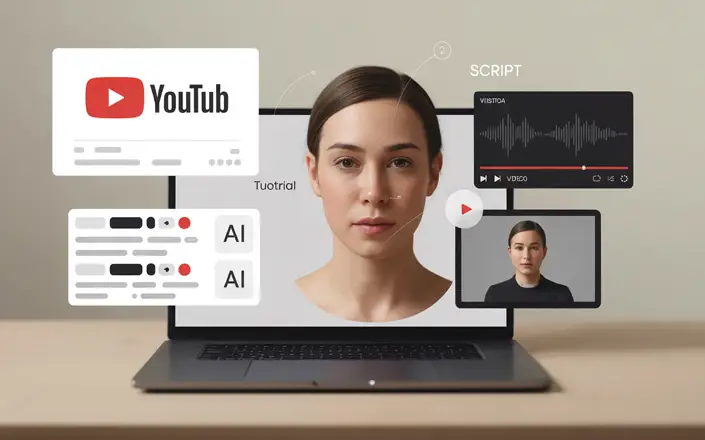
A detailed step-by-step guide explaining how to build a profitable faceless YouTube channel in 2026 using AI video automation. Learn how to research high-intent “how-to” topics, create automated tutorial videos with AI tools, optimize YouTube SEO for search-based traffic, and monetize tutorials without showing your face through ads and affiliate income.
If you’ve ever searched “how to do something” on YouTube, chances are you didn’t care who was on camera you cared about the answer. That simple behavior shift is the exact reason why the faceless YouTube channel model is exploding in 2026.
Today’s viewers especially adults between 30 and 55 are outcome-driven. They want clarity, speed, and reliability. They’re not looking for influencers dancing in thumbnails. They’re looking for solutions. And YouTube, quietly, has become the second-largest search engine in the world for that exact reason.
What’s changed recently is AI video automation.
In the past, launching a YouTube channel meant:
That alone stopped millions of capable people from ever starting.
In 2026, AI removes nearly all of those friction points.
You can now:
And you can do all of it without ever appearing on camera.
For people who already have careers, families, or simply value privacy, a faceless YouTube channel is no longer a side experiment it’s a scalable digital asset.
What makes this model even more powerful is search-based longevity. A well-optimized tutorial like “how to format a book for Kindle Direct Publishing” can bring in views, ad revenue, and affiliate commissions for years, not days.
This guide is designed to walk you through the entire system, step by step starting with understanding what a faceless AI-powered channel really is, and how it works in today’s YouTube ecosystem.
Before diving into tools or tactics, it’s important to clearly understand the business model.
A faceless YouTube channel is exactly what it sounds like: a channel where your identity is not the product. There’s no personal brand, no on-camera personality, and no lifestyle storytelling. The content stands on its own.
Instead of who you are, the channel is built around what problem you solve.
Faceless does not mean low-quality or generic.
It means:
Most successful faceless channels focus on:
Common examples include:
Channels like these don’t rely on charisma they rely on clarity and accuracy.
This is where AI video automation completely changes the equation.
In 2026, AI tools can handle nearly every production step:
This allows creators to focus on strategy, not technical execution.
According to YouTube’s own Creator Insider insights, videos with clear instructional intent and strong retention signals are prioritized in search-based recommendations
In simple terms: if your video solves a problem efficiently, YouTube wants to show it.
“How-to” content is uniquely compatible with automation because it follows a predictable structure:
That consistency makes it ideal for:
And most importantly, it attracts high-intent viewers people actively trying to accomplish something.
That intent is what drives monetization later.
A faceless YouTube channel succeeds or fails before the video is ever created. Topic selection is everything.
You are not trying to go viral.
You are trying to be useful at the exact moment someone searches for help.
There are two main types of YouTube traffic:
Browse content spikes quickly and fades.
Search content compounds slowly and lasts.
If someone searches “how to create automated YouTube videos with AI tools”, they have intent. That viewer is far more valuable than someone passively scrolling.
This is why search-driven faceless channels often earn more per video over time than viral entertainment channels.
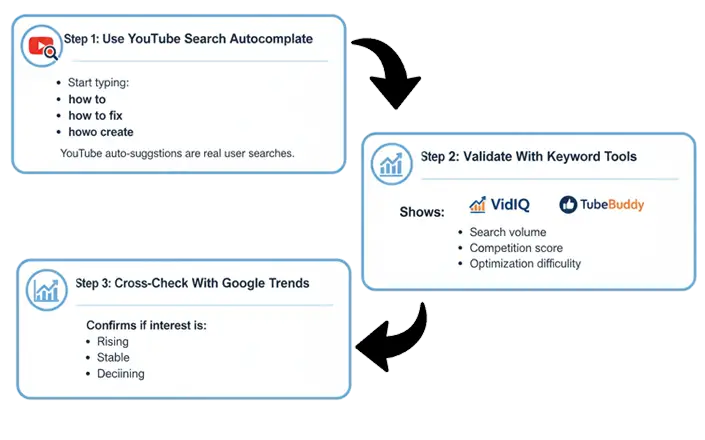
Here is a practical, repeatable process used by successful creators:
Step 1: Use YouTube Search Autocomplete
Start typing:
YouTube auto-suggestions are real searches, not guesses.
Step 2: Validate With Keyword Tools
Use platforms like:
These tools show:
Step 3: Cross-Check With Google Trends
Google Trends helps confirm whether interest is:
Evergreen topics matter more than short-lived spikes.
Based on current demand patterns, the following niches are particularly strong:
For Example:
“How to format a book in Kindle Direct Publishing”
This single topic:
Amazon’s own KDP documentation confirms formatting remains one of the top friction points for new authors
https://kdp.amazon.com
That friction equals opportunity.
Once you’ve selected the right topic, the next step is turning that idea into a clear, structured tutorial. This is where many creators fail not because of tools, but because of poor explanations.
In a successful faceless YouTube channel, the script is the product. The video is simply the delivery mechanism.
YouTube’s algorithm in 2026 heavily rewards:
If viewers click your video but leave after 30 seconds, it won’t rank no matter how good your SEO looks on paper.
A well-written tutorial script does three things:
For viewers between 30 and 55, clarity matters more than speed. They don’t want hype they want confidence that they’re following the right process.
AI has dramatically changed how scripts are created, but quality depends on how you guide the AI.
ChatGPT is particularly effective for:
Instead of asking:
“Write a YouTube script”
A better prompt would be:
“Write a detailed, beginner-friendly, step-by-step tutorial explaining how to [task]. Assume the viewer has no prior experience. Use clear transitions and practical explanations.”
This approach produces scripts that feel human, not robotic.
OpenAI’s own documentation emphasizes that structured prompts lead to clearer, more accurate outputs
https://platform.openai.com/docs
That clarity directly translates to higher viewer trust.
Every high-performing tutorial follows a similar framework:
1. The Hook (First 10–15 seconds)
2. Overview of the Process
3. Step-by-Step Instructions
4. Common Mistakes
5. Recap + Next Step
This structure is ideal for a faceless YouTube channel because it works consistently across topics, niches, and tools.
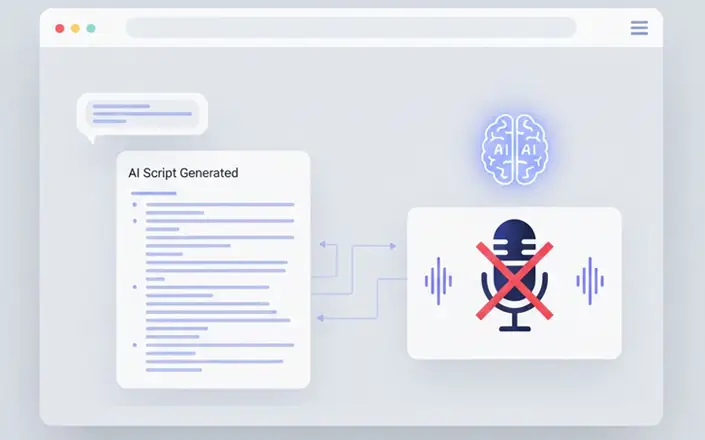
For many people, this is the biggest psychological barrier:
“I don’t want to record my voice.”
The good news? You don’t need to.
Modern AI voice technology has reached a point where most viewers cannot tell the difference especially in instructional content.
Even though the channel is faceless, audio quality is non-negotiable.
Poor audio leads to:
For instructional videos, viewers expect a calm, professional tone similar to what they’d hear in a corporate training or software demo.
Several platforms now specialize in realistic voice generation:
These tools allow you to:
For a US-focused audience, neutral American accents consistently perform best.
To keep your videos sounding human:
A calm, confident voice aligns well with search-based video content, where viewers are actively learning not being entertained.
When done correctly, AI voiceovers blend seamlessly into a fully automated workflow and support long-term scaling.
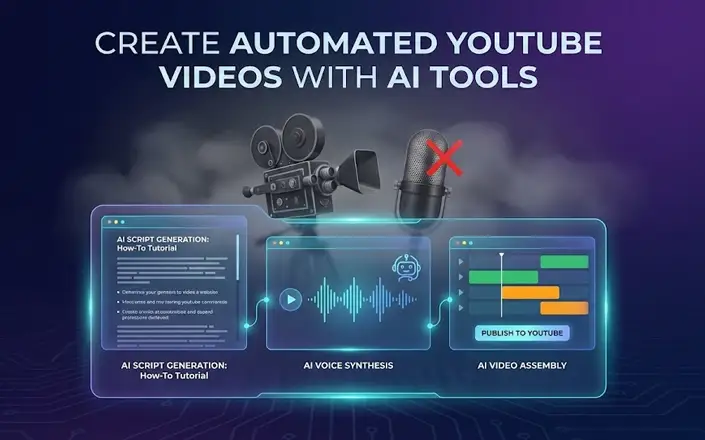
This is where AI video automation becomes a real force multiplier.
At this stage, you already have:
Now you need visuals that support the explanation without filming.
The most effective formats include:
Most successful creators combine screen recordings + captions, especially for “how-to” content.
Several tools simplify video assembly:
These platforms allow you to:
This dramatically reduces production time sometimes to under 30 minutes per video.
Captions are no longer optional.
They:
YouTube itself confirms captions can positively impact watch time and engagement
https://support.google.com/youtube
For a faceless YouTube channel, captions also compensate for the lack of on-screen personality by reinforcing clarity.
You can create the best tutorial in the world, but if YouTube doesn’t understand what your video is about, it won’t surface it. This is where YouTube SEO becomes the engine behind a profitable faceless YouTube channel.
The good news is that SEO for “how-to” content is far more predictable than entertainment content.
YouTube now prioritizes relevance + satisfaction, not just keywords.
Its system looks at:
For instructional videos, this works in your favor because viewers are actively trying to solve a problem.
Google itself confirms that helpful, people-first content is rewarded across platforms
https://developers.google.com/search/docs/fundamentals/helpful-content
This applies directly to YouTube search results.
Your title should:
Example:
How to Format a Book for Kindle Direct Publishing (Step-by-Step Tutorial)
This format:
Avoid clever wording. Clarity wins every time especially for a faceless YouTube channel.
Descriptions still matter, particularly for search-based traffic.
Best practice:
This helps YouTube contextualize your content and improves discoverability.
For tutorials, thumbnails should signal:
This is where the model becomes a real income system, not just a content project.
A properly structured faceless YouTube channel can monetize in multiple layers at the same time.
Once eligible, ads provide baseline income.
Key points:
This is not “get rich quick,” but it is predictable.
Affiliate marketing is where most faceless channels outperform traditional creators.
Why?
Examples:
Affiliate platforms like Impact and Partnerize work well for SaaS products
https://impact.com
A single well-ranked tutorial can generate commissions for years without updates.
This is the hidden advantage most people overlook.
Unlike social media posts that disappear in days, a ranking tutorial:
That’s why many creators quietly build libraries of “how-to” videos instead of chasing trends.
Once the system works once, scaling is about repeatability, not creativity.
A proven workflow looks like this:
Every step can be templated.
Most successful creators don’t publish daily. They publish consistently.
Options:
This fits perfectly for professionals with limited time.
Once confident, you can:
At this stage, your faceless YouTube channel becomes a content system, not a side hustle.
Avoiding these keeps the channel sustainable.
Even with AI, mistakes can slow growth.
For people aged 30–55 those with experience, discipline, and patience this model makes sense.
A faceless YouTube channel:
With AI video automation, the barrier to entry has never been lower but consistency and intent still matter.
If you focus on helping first, monetization follows naturally.
That’s the real fortune behind faceless YouTube in 2026.