Physical Address
304 North Cardinal St.
Dorchester Center, MA 02124
Physical Address
304 North Cardinal St.
Dorchester Center, MA 02124

Most people enter profitable niches too late. This guide shows you how to use AI niche prediction to uncover trending micro-niches, validate demand, and dominate markets before they explode. Learn the exact tools, frameworks, and validation steps serious online entrepreneurs use to stay ahead.
If you’ve ever felt like you’re always one step behind when it comes to making money online, you’re not alone. Most people don’t fail because they’re lazy or inexperienced they fail because they enter markets after the opportunity window has already closed. That’s exactly why AI niche prediction is becoming one of the most valuable skills for online entrepreneurs right now.
Here’s the hard truth: by the time a niche is all over YouTube, flooded with ads, and packed with “gurus,” the easy money is already gone. You’re competing with established brands, massive ad budgets, and websites that have years of authority behind them. That’s not a smart game to play especially if you’re in your 30s, 40s, or 50s and value efficient, lower-risk income strategies.
What does work today is spotting trends before they go mainstream when competition is low, demand is quietly building, and buyers are actively searching for solutions. This is where AI niche prediction completely changes the game. Instead of guessing, you use data. Instead of reacting, you position yourself early.
In this guide, you’ll learn how to use artificial intelligence not as a content-writing gimmick, but as a strategic forecasting tool one that helps you identify trending micro-niches, underserved audiences, and real commercial opportunities months or even years before they peak.
And no, this isn’t theory. This is the same process that allowed early movers to dominate niches like keto snacks, home workout equipment, and remote-work software long before they became competitive.
Before we go any further, we need to clear up a massive misconception.
When most people hear “AI,” they think about blog writing, chatbots, or social media captions. That’s surface-level thinking and it’s why so many people are using AI incorrectly.
AI niche prediction has nothing to do with replacing your voice or creativity. It’s about using artificial intelligence to analyze massive datasets that humans simply can’t process manually.
At its core, AI niche prediction is the process of using machine learning, pattern recognition, and behavioral data analysis to identify early demand signals in the market.
AI looks at things like:
When you combine these signals, AI can highlight where attention and money are moving next not where they’ve already been.
For example, humans might notice that “sustainable products” are popular. AI, on the other hand, can identify that searches for “eco-friendly dog products for apartment living” are rising at a faster rate than the broader trend. That’s the difference between a broad niche and a profitable micro-niche.
This is also why tools for finding profitable niches with AI are becoming essential. They don’t rely on opinions they rely on evidence.
If you’ve been online long enough, you’ve probably heard advice like:
“Pick a big niche so you don’t limit yourself.”
That advice is outdated.
In today’s market, specific beats broad almost every time.
A micro-niche focuses on:
For example:
These types of niches are easier to rank for, easier to monetize, and far more appealing to advertisers and affiliate programs especially in Tier-1 countries like the US, UK, Canada, and Australia.
AI helps you discover these underserved audiences with data analysis instead of guesswork. When AI detects a fast-growing but low-competition segment, you’re seeing opportunity before everyone else piles in.
This is one of the most practical ways to future-proof your income online.
Now let’s talk about how AI actually predicts trends because this is where the real advantage lies.
AI doesn’t predict the future in a crystal-ball sense. It identifies patterns forming right now that historically lead to explosive growth later.
AI analyzes thousands of signals at the same time, including:
When people start searching for new problems, tools, or solutions even in small numbers AI flags that movement. Over time, these small increases often turn into major trends.
Platforms like:
are commonly used to predict market trends using artificial intelligence by tracking these changes early.
AI-powered social listening tools monitor:
When people repeatedly complain about the same problem or ask the same questions, that’s a commercial signal. AI detects those clusters far faster than manual research.
This is a powerful way to discover trending micro-niches that haven’t yet been monetized properly.
AI also analyzes:
When money flows into a space quietly, consumer demand usually follows. This is how AI for keyword and trend research connects financial data with audience behavior.
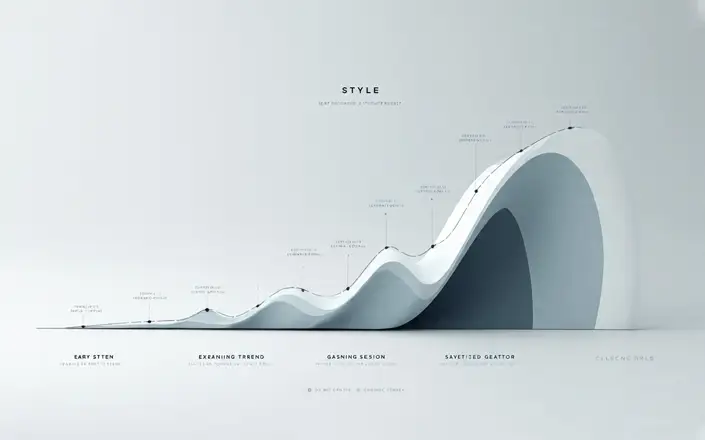
Every profitable niche follows a predictable lifecycle:
Most people enter at stage 3 or 4.
AI niche prediction allows you to enter at stage 1 or 2.
That’s the difference between building a long-term digital asset and constantly chasing the next shiny object.
Tools like Trend Hunter and Exploding Topics are especially useful here because they focus on emerging trends, not already-popular ones.
Why This Matters If You’re 30–55 Years Old
At this stage of life, time matters. You don’t want to gamble on hype or burn months on ideas that won’t work. You want calculated moves, predictable outcomes, and strategies that scale.
Using AI niche prediction is exactly that a smarter way to build online income without relying on luck.
Once you understand why AI niche prediction works, the next logical question is:
“Which tools should I actually use and how?”
This is where most bloggers either overcomplicate things or chase every new software launch. The reality is, you don’t need dozens of tools. You need a small, focused stack that helps you spot trends early, analyze intent, and confirm commercial value.
Let’s break down the most reliable tools for finding profitable niches with AI and how real people use them, not how sales pages describe them.
Exploding Topics is one of the best-known platforms for identifying emerging trends early. What makes it powerful is its focus on growth velocity, not just raw numbers.
Instead of showing you what’s already popular, it highlights:
This makes it ideal for AI niche prediction.
How to use it effectively:
For example, instead of chasing “AI tools” broadly, you might spot:
Each of these represents a trending micro-niche with different monetization paths.
You can explore it here:
https://explodingtopics.com
Google Trends is free but most people use it wrong.
They type in a keyword, see a flat line, and move on. That’s not how professionals use it.
When combined with AI-style analysis, Google Trends becomes a powerful way to predict market trends using artificial intelligence logic, even without paid tools.
Smart ways to use Google Trends:
For example:
Instead of searching “home workouts,” compare:
If one term shows steady upward movement while competition remains low, you’ve likely found an underserved audience with buying intent.
Google Trends: (https://trends.google.com)
This is where AI for keyword and trend research becomes more about pattern recognition than automation.
Trend Hunter works slightly differently. It focuses less on keywords and more on human behavior, lifestyle shifts, and cultural changes.
That’s incredibly useful if your blog targets:
Trend Hunter helps answer questions like:
This is how you discover underserved audiences with data analysis before search volume even spikes.
Trend Hunter: (https://www.trendhunter.com)
When Trend Hunter insights line up with early Google Trends data, you’re usually looking at a strong opportunity.
Spotting a trend is only half the job. The real skill the one that separates successful bloggers from everyone else is turning a trend into a monetizable micro-niche.
This is where AI niche prediction becomes practical.
Whenever you find a trend, run it through this simple framework:
1. Is there a clear problem?
People pay to remove pain, save time, or reduce risk.
2. Is the audience specific?
“Everyone” is not a buyer persona.
3. Is there purchasing intent?
Are people already spending money here or trying to?
4. Can it scale?
Can this niche support content, products, or affiliates long-term?
For example:
This niche works because:
That’s how AI niche prediction helps you think like a market analyst, not a blogger chasing traffic.
Here are a few niches that are showing early signals right now:
Each of these niches:
This is why tools for finding profitable niches with AI are so valuable they help you narrow fast without emotional bias.
One of the biggest mistakes people make is falling in love with an idea before validating it.
Validation is where most failed blogs could have been saved.
You don’t need massive search volume. You need:
AI for keyword and trend research helps you identify:
These keywords indicate people are close to spending money.
Tools like Ahrefs, SEMrush, or even AI-assisted keyword analysis can confirm whether a niche has commercial depth.
Example tools for reference:
aHrefs: https://ahrefs.com
SEM Rush: https://www.semrush.com
Before committing, ask:
If you see weak content ranking, that’s a green light.
AI niche prediction shines here because it often uncovers niches before SEO competition catches up.
Finally, confirm:
If money is already flowing even quietly you’re on the right track.
One of the fastest ways to understand AI niche prediction is to look backward. When you analyze past winners, patterns become obvious and those same patterns are happening again right now in different markets.
Let’s break down a few real examples and connect them to how AI-based trend analysis could have spotted them early.
Most people remember “keto” as a massive, competitive health trend. What they forget is that it didn’t start that way.
Early signals included:
AI tools for keyword and trend research would have flagged:
These were trending micro-niches before big brands entered the space.
Those who built content sites, email lists, or product brands early didn’t need to compete on price later they already owned attention.
The home workout niche didn’t start in 2020. AI-driven analysis shows rising interest years earlier in:
AI niche prediction would have highlighted:
By the time mainstream media caught on, early movers had:
This is why predicting trends matters more than reacting to them.
This is one niche where the window is still open but not for long.
Broad keywords like “AI tools” are already competitive. However, AI niche prediction reveals sub-niches like:
These segments have:
This is a textbook example of how to discover underserved audiences with data analysis rather than chasing crowded keywords.
Knowledge without execution doesn’t pay the bills. This is a practical, realistic action plan designed for people with jobs, families, and limited time.
Week 1: Trend Discovery
This is where AI niche prediction starts doing the heavy lifting.
Week 2: Validation & Research
No validation = no commitment.
Week 3: Content & Asset Creation
AI for keyword and trend research helps here by shaping content around real demand.
Week 4: Monetization & Positioning
This is how small blogs turn into long-term income assets.
Even with AI niche prediction, mistakes happen. Here are the most common ones and how to avoid them.
Mistake #1: Entering Too Late
If everyone is talking about it, you’re already late.
Mistake #2: Ignoring Commercial Intent
Traffic without buyers is a hobby, not a business.
Mistake #3: Over-Reliance on One Tool
AI works best when multiple signals align not when you trust a single dashboard blindly.
Mistake #4: Chasing Hype Instead of Patterns
Short-term hype fades. Structural trends grow.
Understanding these mistakes is just as important as knowing how to predict market trends using artificial intelligence.
We’re entering a phase where data-driven decision-making will separate winners from everyone else.
In the past, big companies had access to trend data. Today, solopreneurs and bloggers do too through AI-powered platforms and analysis tools.
Here’s what the future looks like:
AI niche prediction isn’t a shortcut. It’s a competitive advantage especially for people who don’t want to gamble with time or money.
If you’re serious about building a future-proof income, the goal isn’t to chase trends.
The goal is to see them coming and act early.
Final Thoughts: AI Is the Strategy, Not the Business
AI won’t replace your judgment, experience, or voice. But it will make your decisions sharper.
Used correctly, AI niche prediction helps you:
And in a world where attention is expensive and competition is everywhere, that edge matters.
Relevant Resources (External References)