Physical Address
304 North Cardinal St.
Dorchester Center, MA 02124
Physical Address
304 North Cardinal St.
Dorchester Center, MA 02124


AI affiliate marketing has become one of the more interesting ways to build an online income stream, but choosing the right program is harder than it looks. Search for the best AI affiliate programs, and you will find huge lists filled with dozens of software companies, impressive commission percentages, and short product descriptions.
The problem is that a long list does not tell you which programs are actually worth promoting.
A 50% commission does not automatically make an affiliate program better. A 60-day cookie does not guarantee conversions. And a recurring commission is not very useful if the product has poor audience fit or is difficult to sell.
That is why this guide takes a different approach.
Instead of throwing dozens of programs at you, we researched the best AI affiliate programs using factors such as commission structure, recurring earning potential, product value, audience fit, cookie duration, attribution, approval requirements, promotional difficulty, and content opportunities.
The goal is simple: help you identify the best AI affiliate programs for your particular audience rather than telling you to join every program you can find.
Affiliate disclosure: Some links in this article may be affiliate links. If you purchase through one of these links, we may earn a commission at no additional cost to you. Our recommendations are based on the evaluation criteria explained in this article.
Program information: Affiliate commissions, pricing, cookies, eligibility, and program rules can change. Always verify the current terms on the company’s official affiliate page before applying.
If you want the short answer, these are the seven programs we selected for deeper comparison:
| AI Affiliate Program | Best For | Commission Model | Strongest Advantage |
| Writesonic | SEO and content publishers | Recurring | Strong fit for SEO-focused audiences |
| VEED | YouTubers and creators | Initial + recurring | Easy-to-demonstrate AI video product |
| HubSpot | B2B and marketing audiences | Recurring | High-value business software |
| Jasper | Marketing professionals | Recurring | Strong marketing-content positioning |
| GetResponse | Bloggers and small businesses | Recurring | Email marketing + automation |
| Semrush | SEO publishers and marketers | Sale/trial based | High commercial value |
| Pictory | Beginner video creators | One-time | Simple AI video monetization angle |
The important point is that there is no single winner for everyone.
The best AI affiliate programs depend heavily on what your audience already wants to buy.
A YouTube audience interested in faceless videos may respond better to an AI video platform. An SEO audience may be much more interested in SEO software. A small-business audience may have stronger buying intent for CRM, marketing automation, or email software.
That audience-product match can matter more than the headline commission percentage.
Before looking at individual companies, it helps to understand how the programs were evaluated.
Many affiliate articles rank programs almost entirely by commission percentage. That approach can be misleading.
For example, imagine two software products.
One pays 50% on a $20 purchase.
The other pays 20% on a $200 subscription.
The first program has the higher percentage. The second can generate the larger commission.
That is why the best AI affiliate programs should be evaluated using the complete economics of the offer rather than one number.
Commission percentage is still important, but it is only the starting point.
We look at:
This helps answer a more useful question:
How valuable could a qualified customer actually be to an affiliate?
Recurring commissions can be attractive because one referral may generate more than one payment.
However, recurring does not automatically mean better.
A recurring commission may stop after a specific period. Customers can cancel. Plans can change. Affiliate terms can also change.
So when comparing the best AI affiliate programs, we look at the entire commission window rather than simply putting a “recurring” label beside a product.
Cookie duration determines how long a referral can potentially remain attributed to an affiliate after someone clicks a tracked link.
A longer cookie can be useful when customers need more time to research before purchasing.
But cookie duration should never be viewed in isolation.
The actual attribution rules matter too.
For example, affiliates should understand whether the program uses last-click attribution, how referrals are tracked, and whether specific promotional methods are restricted.
This is one of the most overlooked factors in affiliate marketing.
If you would not recommend a product to a friend, it probably should not become a major part of your affiliate strategy.
A strong commission cannot fix a weak product.
The best AI affiliate programs should offer something genuinely useful to the audience you are trying to reach.
We also consider who is most likely to buy the product.
Possible audiences include:
This matters because the same software can be highly relevant to one audience and almost irrelevant to another.
Some AI products are easy to demonstrate.
An AI video editor, for example, can be shown through a simple before-and-after video.
Other products require much more explanation.
You may need:
A product with excellent content potential can sometimes be easier to monetize than one offering a larger commission.
We also consider whether a smaller publisher can realistically start promoting the program.
Important questions include:
This is particularly important if you are looking for the best AI affiliate programs for a new or relatively small website.
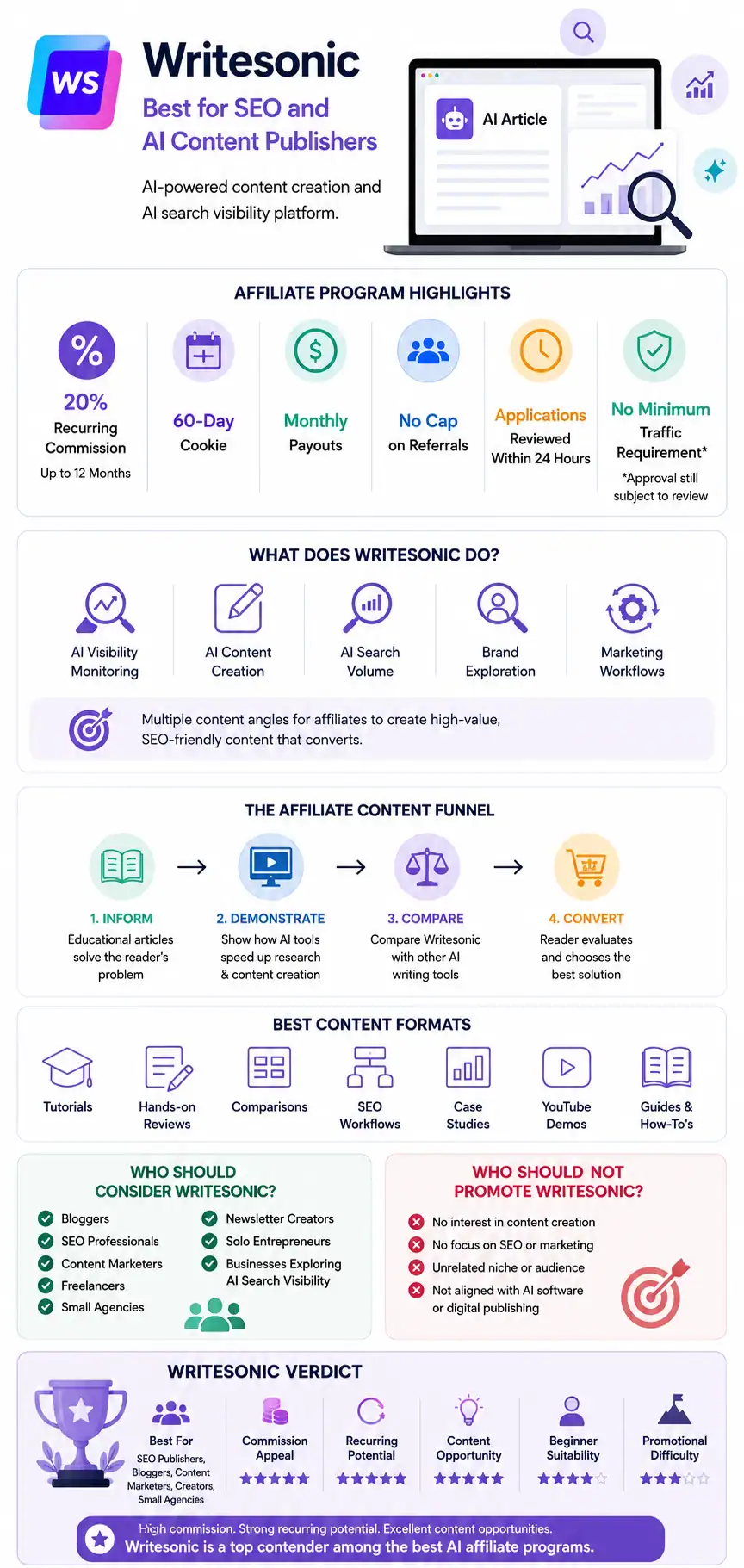
Writesonic is one of the strongest candidates in this comparison if your audience is interested in SEO, content marketing, AI visibility, or content creation.
The company currently advertises 20% recurring commission for up to 12 months, with a 60-day cookie and monthly payouts through FirstPromoter. Its current affiliate page also states that most applications are reviewed within 24 hours and that there is no minimum traffic requirement.
That combination makes Writesonic particularly interesting for publishers who do not have a massive audience yet.
Writesonic positions itself around AI-powered content and AI search visibility.
Its current platform includes tools and features related to AI visibility monitoring, AI content creation, AI search volume, brand exploration, and related marketing workflows.
That gives affiliates multiple content angles.
Instead of publishing one generic review, you could build a complete content cluster around topics such as:
This is one reason Writesonic stands out among the best AI affiliate programs for SEO-oriented publishers.
The current affiliate program advertises:
The current program also provides affiliates with tracking links and promotional resources. Its application form asks applicants where they plan to promote Writesonic and requests information about their website or other promotional platforms.
That last point is worth remembering.
“No minimum traffic requirement” does not mean “automatic approval.”
The company still evaluates affiliate applications.
Writesonic has a particularly natural connection with SEO content.
Imagine someone searching for:
“How can I create better SEO content with AI?”
That person may already have commercial interest in an AI content platform.
This is much stronger than inserting an affiliate link into an unrelated article.
For a blog publisher, the ideal strategy is to create educational content first and introduce the product where it genuinely solves the reader’s problem.
For example:
Informational article:
“How to Build an AI Content Workflow for a Small Website”

Product demonstration:
“Here is where an AI content platform can speed up the research and drafting process.”
Commercial comparison:
“Writesonic vs. other AI writing tools”
Affiliate opportunity:
The reader can evaluate the product and decide whether it fits their needs.
That is a much stronger approach than simply writing:
“Writesonic pays 20%, so join today.”
If you promote Writesonic, focus on content that demonstrates the product.
Good formats include:
This gives Writesonic strong content potential, which is one of the criteria we use when identifying the best AI affiliate programs.
Writesonic may be particularly relevant if your audience includes:
The company’s affiliate page specifically highlights creators, newsletter writers, SEO consultants, fractional CMOs, solo marketers, and indie operators as potential partners.
Writesonic may be a poor fit if your audience has little interest in:
The lesson is important:
Do not choose an affiliate program because its commission looks attractive. Choose it because your audience has a reason to buy the product.
Best for: SEO publishers, bloggers, content marketers, creators, and small agencies.
Commission appeal: High.
Recurring potential: Strong.
Content opportunity: Excellent.
Beginner suitability: Good, although approval is still subject to the program’s application process.
Promotional difficulty: Moderate.
For an SEO-focused publisher, Writesonic deserves serious consideration among the best AI affiliate programs available this year.
VEED is another strong candidate, especially if your audience includes YouTubers, social-media creators, educators, marketers, or people building faceless content businesses.
The attraction here is simple:
Video software is easy to demonstrate.
That gives affiliates a major content advantage.
Instead of telling readers that an AI video platform is useful, you can show them.
VEED is an online video creation and editing platform with AI-powered features.
For an affiliate publisher, the important point is not simply the feature list.
It is the number of problems you can create content around.
For example:
This makes VEED particularly interesting for creators who can demonstrate software visually.
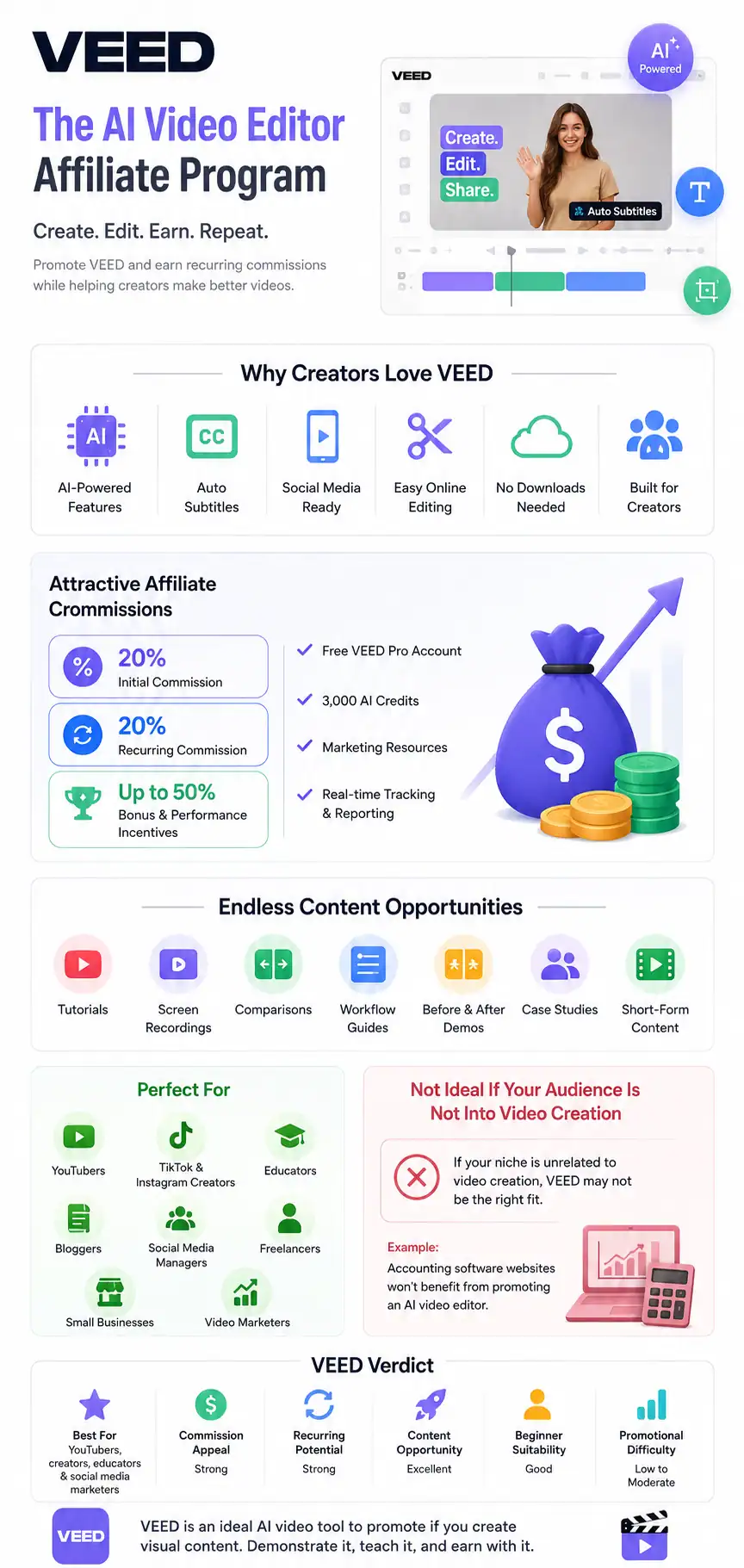
VEED’s current affiliate program advertises 20% initial commission plus 20% recurring commissions.
It also advertises bonus commissions of up to 50% and additional incentives based on performance. Affiliates receive access to promotional resources, a free VEED Pro account, and 3,000 AI credits according to the current affiliate page.
That is a meaningful advantage for affiliates who want to create hands-on demonstrations.
You do not have to rely entirely on screenshots or stock descriptions.
You can potentially create your own tutorials and show the workflow.
Suppose your audience wants to build a faceless YouTube channel.
You could create an article or video explaining:
How to Create a Faceless YouTube Video With AI
Then demonstrate the workflow.
That gives you a natural path:
Problem → Tutorial → Demonstration → Product → Affiliate recommendation
This is much more persuasive than a generic affiliate advertisement.
One particularly useful detail is that VEED explicitly states that affiliates do not need to be influencers or have a large audience. Its current affiliate page says bloggers, educators, social-media marketers, content creators, and affiliate specialists can participate.
That makes VEED worth considering when looking at the best AI affiliate programs for small publishers.
However, you should still think about audience quality.
A small audience with strong interest in AI video can be more valuable than a large audience with no connection to video creation.
VEED is particularly suited to:
This is one of the clearest examples in this guide of why promotional difficulty matters.
A product that can be demonstrated visually gives you more ways to create useful commercial content.
VEED may be a strong fit if your audience includes:
If your audience is primarily interested in areas unrelated to video creation, VEED may not be the right fit.
For example, a website focused entirely on accounting software would have little reason to push an AI video editor.
That is why the best AI affiliate programs are audience-dependent rather than universal.
Best for: YouTubers, creators, educators, and social-media marketers.
Commission appeal: Strong.
Recurring potential: Strong.
Content opportunity: Excellent.
Beginner suitability: Good.
Promotional difficulty: Low to moderate if you can demonstrate the software.
VEED is especially attractive when your affiliate strategy includes YouTube or visual tutorials because the product can become part of the content itself.
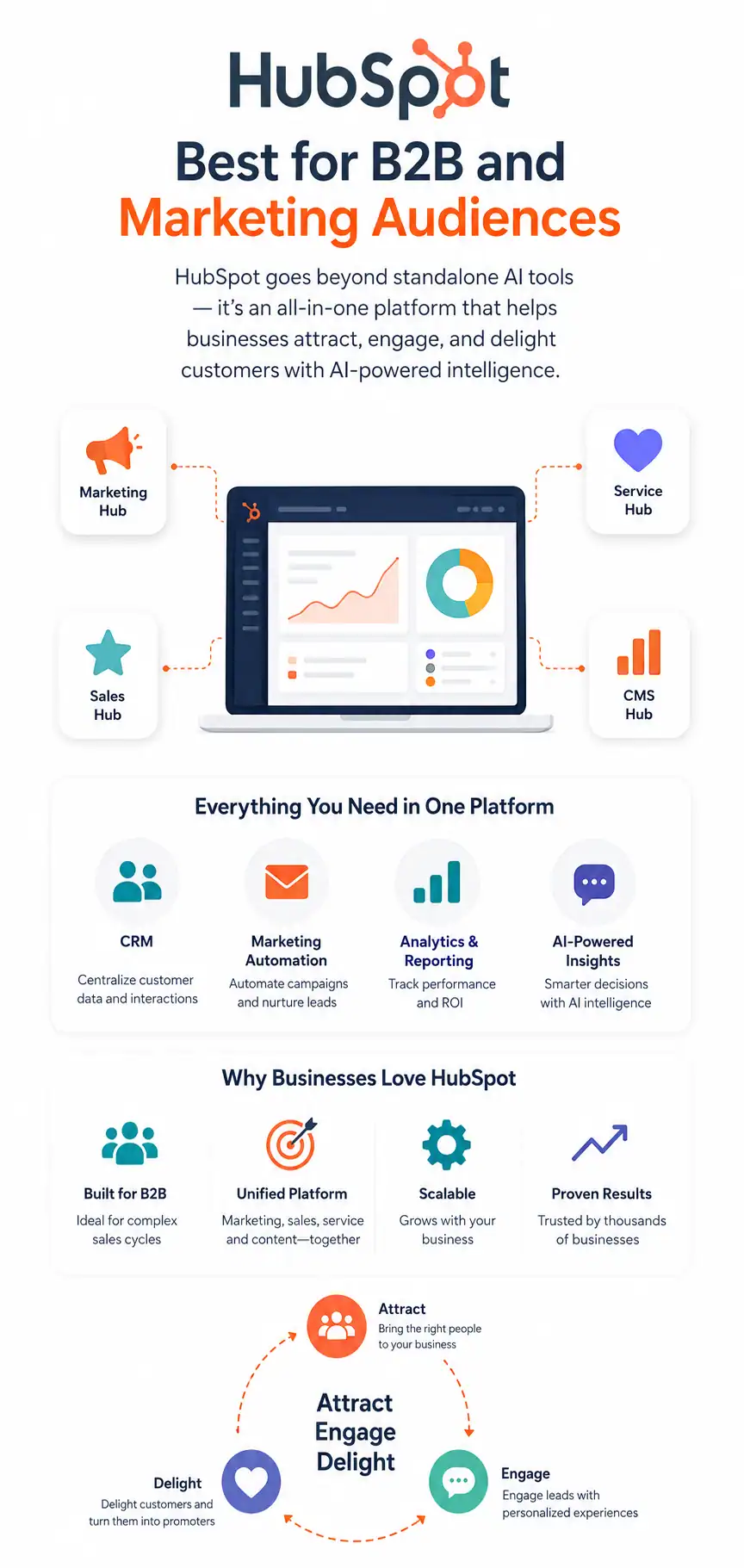
HubSpot is one of the more interesting choices in this list because it takes us beyond standalone AI writing or video tools.
HubSpot is a broader customer platform covering areas such as CRM, marketing, sales, customer service, and operations. Its affiliate opportunity therefore gives publishers access to a much higher-value business audience.
That makes HubSpot particularly relevant when looking at the best AI affiliate programs for B2B publishers.
A reader searching for an AI writing tool may be looking for a relatively narrow solution.
A small business searching for a CRM or marketing platform has a much broader business problem.
They may need to:
That creates a much larger content ecosystem.
Instead of writing one article about HubSpot, a publisher could potentially build an entire cluster around CRM and marketing.
For example:
This is an important distinction.
A good affiliate product should not only provide an opportunity to earn a commission. It should also give you enough content angles to build topical authority.
HubSpot’s current affiliate program advertises 30% recurring commission for up to one year.
The current official affiliate information also lists a 180-day cookie window. (hubspot.com)
That 180-day window is particularly noteworthy.
A reader buying business software may not make a decision immediately.
They may:
A longer attribution window can therefore be valuable.
However, you should never assume that a longer cookie automatically produces more income.
Traffic quality still matters.
HubSpot gives you something that many consumer-focused AI tools don’t:
A strong commercial audience.
Business readers are often searching with specific problems in mind.
Consider the difference between:
“What can AI do?”
and:
“How can my small business automate lead follow-up?”
The second search indicates a much clearer business problem.
That can create stronger commercial intent.
For a Make Money Online website, this is particularly relevant because your audience may include freelancers, entrepreneurs, creators, and small-business owners who are already trying to monetize their skills.
The strongest content usually starts with the problem rather than the affiliate program.
For example:
Problem-focused content
“How to Organize Leads When You Run a Small Online Business”
Educational solution
“Why a CRM can simplify lead management”
Product comparison
“HubSpot vs. Other CRM Platforms”
Product demonstration
“Setting Up a Simple CRM Workflow”
Affiliate opportunity
The reader can evaluate HubSpot for themselves.
That is a much stronger affiliate funnel than simply publishing:
“Join the HubSpot affiliate program.”
HubSpot is not necessarily the easiest product for a brand-new publisher.
The product ecosystem is more complex than a simple AI writing or video application.
That means your content needs to explain the product properly.
But complexity can also create an opportunity.
A complicated product can produce more questions.
More questions can produce more content.
And more useful content can create more opportunities for search traffic.
This is one reason we consider content depth when evaluating the best AI affiliate programs.
HubSpot is especially relevant for audiences interested in:
If your website focuses entirely on low-cost consumer apps or casual side hustles, HubSpot may have less natural relevance.
The product needs to make sense for your reader.
Don’t force a B2B CRM into an article about earning a few dollars from survey apps.
Best for: B2B publishers, marketing websites, agencies, freelancers, and small-business audiences.
Commission appeal: Strong.
Recurring potential: Strong.
Cookie: 180 days according to current official affiliate information. (hubspot.com)
Content opportunity: Excellent.
Beginner suitability: Moderate.
Promotional difficulty: Moderate.
HubSpot is one of the best AI affiliate programs to consider when your audience has genuine business software buying intent.
Jasper is another strong option, particularly for publishers whose audiences are interested in marketing, content creation, advertising, and business growth.
Unlike a general-purpose AI tool, Jasper has positioned itself heavily around marketing use cases.
That positioning can make it easier to create focused commercial content.
Jasper is an AI platform designed around marketing and content workflows.
That gives publishers several potential content angles.
For example:
The narrower positioning can actually be helpful from an SEO perspective.
Instead of trying to explain every possible use of AI, you can target a specific audience with a specific problem.
Jasper’s current official affiliate agreement states that affiliates can earn 25% commission on qualifying Creator and Teams subscriptions, with commissions applying during the customer’s first 12 months under the agreement’s conditions. (jasper.ai)
The agreement also contains important rules around referral validity, promotional practices, and other affiliate requirements.
That is exactly why you should not copy a commission percentage into your article without checking the current official terms.
Affiliate programs are not static.
A company can change:
Consider your reader.
A freelance writer might want an AI writing assistant.
But a marketing agency might need something much broader.
They could be looking for help with:
That creates opportunities for deeper commercial content.
Instead of:
“Jasper is an AI writing tool.”
You can create:
“How Small Marketing Teams Can Use AI to Build a Content Workflow”
Then demonstrate where a tool such as Jasper fits.
That approach is much more useful to readers.
Jasper is particularly interesting for commercial-intent searches.
Examples include:
These readers are often further down the buying funnel.
They may already know what type of product they want.
Your job is to help them make a better decision.
That is the role an affiliate article should play.
Consider:
The strongest approach is to show the product in context.
For example:
Weak approach:
“Jasper is one of the best AI tools.”
Better approach:
“Here is how a small marketing team could use an AI platform to turn one content brief into multiple campaign assets.”
The second example gives the reader a reason to care.
Jasper may fit audiences including:
A publisher whose audience has no interest in business or marketing software may struggle to generate conversions.
Again, the question is not:
“Is this program good?”
The better question is:
“Is this program good for my audience?”
That question should guide every decision you make about the best AI affiliate programs.
Best for: Marketing-focused audiences and business content publishers.
Commission appeal: Good.
Recurring potential: Good, subject to the program’s terms.
Content opportunity: Excellent.
Beginner suitability: Moderate.
Promotional difficulty: Moderate.
Jasper is worth considering when your audience already spends money on marketing and content tools.
GetResponse is a particularly interesting inclusion because it demonstrates an important affiliate marketing principle:
The best affiliate product does not always need to be a pure AI product.
GetResponse is primarily a marketing platform covering email marketing, automation, conversion tools, and related business functions. Its platform also incorporates AI-powered features.
For an affiliate publisher, that broader business utility can be valuable.
Someone trying to make money online eventually needs a way to communicate with an audience.
That could mean:
This creates a natural connection between GetResponse and the Make Money Online audience.
If someone is building a blog, newsletter, digital product business, or online service, email marketing can become part of the monetization system.
That makes GetResponse an interesting candidate among the best AI affiliate programs for entrepreneurs and online marketers.
The current official affiliate program advertises a tiered recurring structure.
The starting tier offers 40% commission for 12 months.
The commission can increase to:
The current program also advertises a 90-day referral cookie. (getresponse.com)
These figures should always be verified before publication because affiliate structures can change.
Let’s imagine you refer a customer who subscribes to a monthly marketing platform.
If the program pays recurring commission for a defined period, the value of that referral can be greater than a simple one-time commission.
But there is an important distinction.
Recurring commission is not the same as lifetime commission.
If a program pays recurring commission for 12 months, you should describe it as a 12-month recurring structure.
Don’t call it:
“Lifetime recurring income.”
Accuracy matters.
GetResponse has a strong relationship with the blogging and email-marketing ecosystem.
A blogger could create content around:
This gives you opportunities for both informational and commercial content.
This is where the program becomes particularly relevant to your website.
A reader might begin with:
“How can I make money from a blog?”
Then learn about:
Eventually, email marketing software becomes a logical part of the conversation.
This creates a contextual affiliate opportunity.
The product is not being promoted simply because it has a commission.
It is being introduced because it solves a problem that emerged naturally in the reader’s journey.
For GetResponse, consider:
It can be a strong fit for:
If your audience has no interest in building an audience, selling products, collecting leads, or marketing a business, the product may not have strong relevance.
Again, audience fit comes first.
Best for: Bloggers, affiliate marketers, newsletter creators, and small businesses.
Commission appeal: Very strong.
Recurring potential: Strong.
Cookie: 90 days according to current official program information. (getresponse.com)
Content opportunity: Excellent.
Beginner suitability: Good.
Promotional difficulty: Moderate.
GetResponse is especially interesting because it can become part of a broader online-business monetization strategy rather than being promoted as just another AI application.
Semrush deserves special attention because SEO audiences can have unusually strong commercial intent.
Someone searching:
“What is SEO?”
is still learning.
Someone searching:
“Best SEO software for an agency”
is much closer to making a purchase.
That distinction makes Semrush particularly interesting for publishers who already create SEO and digital marketing content.
Semrush is a broad digital marketing platform with tools covering areas such as:
Its broad feature set gives publishers many possible content angles.
Semrush’s current affiliate information advertises commissions of up to $450 per sale, depending on the product and partner tier.
The program also advertises commissions for qualifying trial activations and a 120-day cookie. (semrush.com)
The phrase “up to” is important.
You should never write:
“Semrush pays every affiliate $450.”
That would be misleading.
The actual commission depends on the applicable product, conversion, and affiliate conditions.
Semrush is a good example of why customer value matters.
Suppose you have a website attracting SEO professionals.
That audience may already understand why SEO software costs money.
They may be willing to pay for:
That can create stronger commercial intent than a general audience looking for free AI tools.
Don’t rely only on:
“Semrush Review”
Build a broader topic cluster.
For example:
SEO Education
↓
Tool-Based Education
↓
Commercial Content
This creates a complete user journey.
Semrush can be more challenging to promote than simpler tools.
Why?
Because the product has a lot of features.
A reader may need substantial explanation before understanding why they need it.
But that complexity also gives you more opportunities to create useful content.
A single product can support:
This is exactly what we mean by content potential.
Search behavior is changing.
Readers increasingly want to understand how their content and brands appear across traditional search engines and AI-powered search experiences.
That creates an emerging content angle around:
This can make Semrush particularly relevant for publishers covering the intersection of SEO and AI.
Semrush is most suitable for audiences such as:
If your audience is primarily looking for simple, free, beginner-level tools, Semrush may be too advanced or expensive for their needs.
Your recommendation should always consider the reader’s stage.
Best for: SEO publishers, digital marketers, agencies, and advanced bloggers.
Commission appeal: Very strong.
Recurring potential: Depends on the applicable affiliate/product terms.
Cookie: 120 days according to current official affiliate information. (semrush.com)
Content opportunity: Excellent.
Beginner suitability: Moderate.
Promotional difficulty: Moderate to high.
For an SEO-focused audience, Semrush can be one of the more commercially interesting choices among the best AI affiliate programs.
Pictory rounds out our seven-program selection.
Pictory focuses on AI-powered video creation and content repurposing, making it particularly relevant for creators, marketers, bloggers, and people interested in building video content without a traditional production setup.
Video has become a major part of online content.
But many people still face the same barriers:
AI video tools attempt to reduce those barriers.
That makes Pictory particularly relevant to beginners.
Pictory’s current affiliate signup page advertises a 40% one-time commission on a referral’s first payment.
The program also advertises additional partner benefits, including potential access to Pro features, AI credits, sponsorship opportunities, and partner support. (partners.pictory.ai)
This gives us an important comparison point.
Pictory demonstrates that a one-time commission can still be attractive, especially when the commission percentage and product price create a meaningful first-sale value.
This is where many affiliate marketers make a mistake.
They automatically assume:
Recurring = good
One-time = bad
That’s too simplistic.
Suppose Program A pays 20% recurring for several months.
Program B pays 40% on the first payment.
The better program depends on:
This is why we evaluate the economics of the best AI affiliate programs rather than simply ranking them by whether they use recurring commissions.
Pictory gives creators several useful content angles.
For example:
These topics can work especially well when supported by visual demonstrations.
Pictory may be useful for:
If your audience doesn’t create or consume business-oriented video content, the product may not have enough commercial relevance.
Don’t promote a video platform simply because it has an attractive affiliate commission.
Best for: Beginner video creators, bloggers, marketers, and content repurposing.
Commission appeal: Strong.
Recurring potential: No; the current advertised structure is a first-payment commission.
Content opportunity: Excellent.
Beginner suitability: Good.
Promotional difficulty: Low to moderate.
Pictory is an interesting option for publishers who want a straightforward AI video product that can be demonstrated through practical tutorials.
Now that we’ve examined all seven programs, we can compare them side by side.
| Program | Best Audience | Commission Approach | Cookie / Attribution | Content Opportunity | Difficulty |
| Writesonic | SEO and content publishers | 20% recurring up to 12 months | 60 days | Excellent | Moderate |
| VEED | Creators and YouTubers | 20% initial + 20% recurring | Check current terms | Excellent | Low–Moderate |
| HubSpot | B2B and marketers | 30% recurring up to 1 year | 180 days | Excellent | Moderate |
| Jasper | Marketing professionals | 25% under current agreement | Check current terms | Excellent | Moderate |
| GetResponse | Bloggers and marketers | 40%–60% tiered recurring structure | 90 days | Excellent | Moderate |
| Semrush | SEO and agencies | Up to $450 depending on product/tier | 120 days | Excellent | Moderate–High |
| Pictory | Video creators | 40% first payment | Check current terms | Excellent | Low–Moderate |
Important: The figures above reflect the current official program information checked for this article. Affiliate terms can change, so verify the company’s official terms before publishing or applying. (writesonic.com)
The table also shows why there isn’t one universal winner.
Each program has a different economic model and a different ideal customer.
If you are completely new to affiliate marketing, you may be tempted to choose the program with the biggest commission.
Don’t.
Your first priority should be finding a product you can explain and promote naturally.
For many beginners, the best AI affiliate programs will have three characteristics:
Based on those factors, Writesonic, VEED, and Pictory can be interesting starting points.
If you already publish articles about blogging, SEO, AI, or content creation, Writesonic can fit naturally into your content strategy.
You can create tutorials and educational content without making every article an obvious sales pitch.
If you are building a YouTube channel or creator audience, VEED gives you something valuable:
You can demonstrate the product.
That means your audience can see the workflow instead of simply reading about it.
Pictory can also work well for people interested in turning written content into video.
Its visual nature gives you opportunities to create:
These can still be excellent programs, but they may require more sophisticated content.
For example, a HubSpot article may need to explain CRM concepts.
A Semrush article may need to explain keyword research.
A GetResponse article may need to explain email funnels.
Jasper content may need to explain marketing workflows.
That’s not necessarily a disadvantage.
It simply means the promotional strategy should match the product.
Recurring commissions are one of the most attractive concepts in SaaS affiliate marketing.
The basic idea is simple.
Instead of receiving one payment when someone purchases, the affiliate may continue receiving commissions when the referred customer remains eligible under the program’s terms.
But there is a critical distinction between recurring commission and lifetime recurring commission.
The programs in this guide use different structures.
Writesonic currently advertises recurring commissions for up to 12 months. HubSpot advertises 30% recurring for up to one year. GetResponse advertises a 12-month recurring structure at its starting tier, with higher commission percentages at higher performance levels. VEED advertises initial and recurring commissions. (writesonic.com; hubspot.com; getresponse.com; veed.io)
This gives you several different models to compare.
“Which program has the highest recurring percentage?”
Instead ask:
“Which program gives me the strongest combination of customer value, conversion potential, retention, commission rate, and audience fit?”
That is a much better affiliate-marketing question.
Consider two hypothetical scenarios.
You refer a $20/month customer.
Your commission is 20%.
If the customer remains subscribed for six eligible months:
$20 × 20% × 6 = $24
You refer a $100 product.
Your commission is 40%.
You receive:
$100 × 40% = $40
The second program pays more from one customer even though it is not recurring.
These are simplified examples, not predictions of actual affiliate earnings.
The point is to understand the economics.
The best AI affiliate programs should be compared using real customer value rather than a single commission percentage.
After comparing seven different programs, one principle becomes clear:
If your readers need SEO software, Semrush may make sense.
If they need AI content tools, Writesonic or Jasper may be more relevant.
If they create videos, VEED or Pictory may be a better fit.
If they run businesses, HubSpot may have stronger relevance.
If they need email marketing, GetResponse could be the more logical recommendation.
This approach also helps you avoid one of the biggest affiliate marketing mistakes:
promoting products that have nothing to do with the article.
When the recommendation naturally follows the problem, the affiliate link becomes part of the solution rather than an interruption.
There is no universal winner.
The right program depends on what your audience is already searching for and what problems they want to solve.
Here is a practical way to narrow your options.
| Your Audience | Strong Program Choice | Why |
| Bloggers and SEO readers | Writesonic | Strong content and SEO relevance |
| YouTubers | VEED | Easy visual demonstrations |
| Video creators | Pictory | Simple video-focused use cases |
| Marketing professionals | Jasper | Marketing-focused AI workflows |
| Small businesses | HubSpot | CRM and business automation |
| Affiliate marketers | GetResponse | Email and marketing automation |
| SEO professionals | Semrush | Strong commercial SEO intent |
| Agencies | HubSpot / Semrush / Jasper | Higher-value business use cases |
| Beginners | VEED / Pictory / Writesonic | Easier to demonstrate |
| Advanced marketers | Semrush / HubSpot / Jasper | More sophisticated workflows |
The takeaway is simple:
Start with the problem your audience has, then select the affiliate product that solves it.
Do not start with the commission.
Bloggers have a major advantage in AI affiliate marketing.
You can create content around both informational and commercial search intent.
That gives you several opportunities to introduce affiliate products naturally.
For example, imagine your website targets bloggers who want to improve their content.
You could build this content funnel:
How to Create an SEO Content Strategy
The reader wants information.
No hard sell is necessary.
How AI Can Speed Up Content Research
Now the reader understands that software could help.
Best AI Writing Tools for Bloggers
The reader is comparing products.
Writesonic vs. Jasper: Which Is Better for Bloggers?
The reader has stronger buying intent.
Writesonic Review: Features, Pricing, Pros and Cons
The reader may now be ready to purchase.
This is where affiliate links can become much more valuable.
A common mistake is to publish 20 articles that all target variations of:
“Best AI tools.”
That can create a weak website.
Instead, build a topic cluster around a specific audience and problem.
For example:
AI Content
Now your website is covering the topic from multiple search-intent angles.
That is much stronger for both users and search engines.
It also gives you more opportunities to introduce the best AI affiliate programs naturally.
YouTube can be an excellent acquisition channel for AI affiliate marketing.
Why?
Because many AI tools can be demonstrated visually.
A viewer can see:
Input → AI process → Output
That is powerful.
For example, instead of explaining that an AI video tool can create captions, you can record your screen and demonstrate the process.
Instead of claiming that an AI writing tool saves time, you can show a real workflow.
Instead of explaining that SEO software can identify keywords, you can walk through the research process.
If you are targeting creators, consider videos such as:
Then connect each video to a relevant article.
This creates a powerful YouTube → website → affiliate offer funnel.
You don’t need millions of visitors to start affiliate marketing.
In fact, a small website can sometimes outperform a larger general-interest website if it attracts highly targeted visitors.
Imagine two websites.
100,000 monthly visitors.
Most visitors are casually reading AI news.
10,000 monthly visitors.
Most visitors are searching:
“Best AI SEO software for my agency.”
Website B may have far stronger commercial intent.
Traffic volume matters.
But traffic quality matters more for affiliate conversion.
If your website is relatively small, don’t try to compete immediately for enormous keywords such as:
best AI tools
Instead, target narrower searches.
Examples:
These long-tail searches may have less traffic.
But they can have better audience-product alignment.
Use this five-step filter.
If you cannot explain what the software does in simple language, it will be difficult to create useful content.
This is the most important question.
Don’t promote a product simply because it pays well.
Demonstrable products are often easier to promote.
Screenshots, tutorials, workflows, and case studies can all improve the quality of your content.
Look for searches such as:
These searches often indicate that the reader is evaluating a purchase.
One affiliate product should ideally support multiple useful content pieces.
That makes your content investment more efficient.
This is one of the most important sections of the entire article.
Affiliate content fails when the reader feels that the article exists only to generate a commission.
Your goal should be the opposite.
The article should be useful even if the reader never clicks your affiliate link.
That builds trust.
Suppose you’re writing:
How to Create a Faceless YouTube Channel
You discuss:
Now suppose an AI video platform genuinely helps with editing.
You can introduce it at the relevant point.
That’s natural.
You don’t need to mention the product ten times.
This is weak:
“Here are 10 ways to make money online. By the way, try this AI tool.”
There is no connection.
A better approach is:
“If you are creating videos without advanced editing skills, an AI video editor can reduce some of the manual work. Here is what to look for before choosing one.”
Now the recommendation follows the reader’s problem.
Comparison articles are especially valuable for affiliate websites.
People searching:
are often much closer to purchasing.
That makes comparison content an important part of an affiliate SEO strategy.
For example:
Explain who each product is best for.
Compare the most important features.
Explain the current pricing structure.
Discuss the learning curve.
Compare relevant features.
Explain where each platform performs well.
Give a direct recommendation.
Give a separate recommendation.
Explain which product fits which audience.
This structure is useful for readers and also gives search engines and AI systems clear, structured information to interpret.
One of the easiest ways to make your affiliate content more useful is to stop trying to declare one universal winner.
Instead, use categories.
For example:
Writesonic
VEED
Semrush
Jasper
HubSpot
GetResponse
Pictory
This makes the article easier to scan.
It also gives readers an immediate answer.
Affiliate marketing follows a relatively simple mathematical model.
At the basic level:
Visitors × affiliate click-through rate × conversion rate × average commission = affiliate revenue
Let’s use a hypothetical example.
Suppose you receive:
10,000 targeted visitors per month
And:
5% click your affiliate links
That produces:
500 affiliate clicks
Now suppose:
4% of those clicks convert
That’s:
20 customers
If the average commission is:
$30
Your estimated affiliate revenue would be:
20 × $30 = $600
This is only an example.
It is not a prediction of what you will earn.
Actual results vary dramatically depending on traffic quality, product price, commission structure, conversion rate, refunds, attribution, and customer retention.
Recurring programs add another variable:
customer retention.
Suppose a hypothetical software product costs $50 per month.
An affiliate receives 20%.
That means:
$50 × 20% = $10
per eligible month.
If the customer remains subscribed for six months:
$10 × 6 = $60
If they remain for 12 months:
$10 × 12 = $120
Again, these are hypothetical calculations.
The important lesson is that a recurring commission can become more valuable over time.
That is why recurring SaaS programs are often attractive when comparing the best AI affiliate programs.
But you should never assume every customer will remain subscribed for 12 months.
A 50% commission looks impressive.
But percentage alone tells you very little.
Consider:
Product price: $20
Commission: 50%
Commission:
$10
Product price: $100
Commission: 25%
Commission:
$25
Program A has the higher commission rate.
Program B generates the higher commission per sale.
Now add recurring payments and customer retention, and the comparison becomes even more complicated.
That’s why experienced affiliate marketers look at unit economics, not just headline percentages.
Use this basic framework:
Expected affiliate value = average commission × expected eligible duration × conversion probability
You can expand it further:
Expected revenue per visitor = affiliate click rate × conversion rate × average customer value
This is much more useful than saying:
“Program X pays 50%, so it must be better.”
Don’t sign up for 30 programs just because you can.
That usually creates a messy website.
Instead, build a small affiliate stack.
For example:
Writesonic or Jasper
Semrush
VEED or Pictory
GetResponse or HubSpot
Now each product has a purpose.
You can create content around each category without overwhelming your audience.
This is another common mistake.
Imagine an article titled:
How to Create an Email Newsletter
You probably don’t need:
all competing for attention.
Instead, focus on the tools that solve the actual problem.
This improves:
And it reduces affiliate clutter.
A simple spreadsheet can make this much easier.
| Article Topic | Search Intent | Recommended Product | Affiliate Stage |
| How to create SEO content | Informational | Writesonic | Soft recommendation |
| Best AI writing tools | Commercial | Writesonic / Jasper | Strong |
| Writesonic review | Transactional | Writesonic | Strong |
| AI video editing guide | Informational | VEED | Soft |
| Best AI video tools | Commercial | VEED / Pictory | Strong |
| Best SEO software | Commercial | Semrush | Strong |
| Email marketing for beginners | Informational | GetResponse | Soft |
| Best email marketing platforms | Commercial | GetResponse | Strong |
| Best CRM for small business | Commercial | HubSpot | Strong |
| Jasper alternatives | Commercial | Jasper competitors | Strong |
This gives your website a logical monetization structure.
A mature affiliate website should not depend on one article.
Instead, build a funnel.
What Is AI Affiliate Marketing?
↓
How to Use AI Tools to Build an Online Business
↓
How AI Can Speed Up Content Creation
↓
Best AI Writing Tools
↓
Writesonic vs. Jasper
↓
Writesonic Review
This is much stronger than publishing a single “best AI tools” article and hoping it generates commissions.
Because this article is designed for search traffic, SEO should be built into the content architecture.
But avoid treating SEO as keyword repetition.
Modern search requires topical coverage.
You should demonstrate that the article understands:
That creates stronger topical relevance.
Your primary keyword for this article is:
best AI affiliate programs
It should appear in:
But don’t force it into every paragraph.
Your requested target of 35–57 uses across the complete article should be handled across all parts, with natural variations around it.
Use semantic variations such as:
This creates broader topical coverage without making the article sound robotic.
Search is no longer only about traditional blue links.
Your content should also be easy for AI systems to understand and summarize.
That means important answers should be explicit.
For example:
Answer: Beginners should prioritize AI affiliate programs that offer a useful product, straightforward promotion opportunities, clear affiliate terms, and strong audience fit. Programs such as Writesonic, VEED, and Pictory can be considered when they match the publisher’s audience and content strategy.
This structure gives the reader an immediate answer.
Then the article can provide the supporting explanation.
Tables are especially useful for affiliate content.
They allow readers to quickly compare:
But don’t put every possible detail into one enormous table.
A table should summarize.
The sections below it should explain.
This is where your article can become more valuable than generic affiliate lists.
Don’t just write:
“This program pays 30%.”
Explain:
“A 30% recurring commission may be more attractive for a SaaS product than a larger one-time percentage because the affiliate can potentially earn from multiple eligible billing periods.”
That’s analysis.
Similarly:
“A 180-day cookie may be particularly useful for expensive business software because customers often require more research before purchasing.”
That’s useful context.
This is particularly important for a Make Money Online website.
AI affiliate marketing can generate recurring commissions.
But that doesn’t mean income is automatic.
You still need to:
Recurring commissions can become semi-passive after the traffic and content system is established, but the system still requires maintenance.
Avoid claims such as:
“Make $10,000 every month automatically.”
Instead, explain the mechanism and show realistic examples.
A 60% commission means nothing if nobody buys the product.
Fix: Evaluate product-market fit and customer value.
Twenty affiliate links can make an article look like an advertisement.
Fix: Recommend fewer products and explain why they fit.
A review copied from the company’s feature page provides little value.
Fix: Include practical workflows, limitations, screenshots, comparisons, and who should or shouldn’t use the product.
If your article says:
“This is the best tool.”
Readers may wonder:
“Compared with what?”
Fix: Include meaningful alternatives.
Commission structures change.
Cookie windows change.
Programs close.
Eligibility rules change.
Fix: Check official affiliate terms before publishing and during scheduled content updates.
This is especially dangerous in SaaS affiliate content.
A commission rate from an old article may no longer apply.
For example, third-party affiliate lists published recently can disagree with each other about current commission structures. That is precisely why your final published article should rely on current official program pages for commission claims rather than copying another “best programs” list.
Transparency matters.
Your disclosure should make it clear that you may receive compensation if a reader purchases through an affiliate link.
Keep it visible and understandable.
For example:
Affiliate Disclosure: This article may contain affiliate links. If you purchase a product through one of our links, we may earn a commission at no additional cost to you. We only recommend products that we believe may be useful to our readers.
Then make sure your actual affiliate practices and disclosures comply with the applicable rules in the markets you target.
Getting traffic is only one part of the equation.
You also need to help readers make decisions.
Instead of:
Click here.
Try:
Explore Writesonic
or:
See the current VEED plans
The CTA should describe the action.
Don’t put an affiliate button immediately after the title.
Give the reader enough context to understand why the product may be useful.
Then provide the next step.
People hesitate before buying software.
They may wonder:
Good affiliate content answers those questions.
This can actually improve trust.
If a product has a limitation, explain it.
For example:
“This tool may be overkill for someone who only needs basic video editing.”
That sentence doesn’t necessarily hurt conversions.
It can increase credibility.
Readers know you are not blindly recommending everything.
Trust is particularly important in the Make Money Online niche.
Readers have seen exaggerated income claims for years.
Therefore, your content should avoid:
Instead, focus on:
This is a stronger long-term SEO strategy.
Yes, but don’t turn every social post into an affiliate advertisement.
A better approach is to create educational content.
For example:
“3 AI tools that can save a blogger hours every week.”
Then demonstrate one tool.
“7 AI tools for a one-person online business.”
“I tested three AI video editors for a faceless YouTube workflow.”
Create an infographic:
“AI Affiliate Marketing Funnel for Beginners.”
Then direct traffic to your detailed article.
The content should provide value first.
A strong system can look like this:
SEO article
↓
YouTube tutorial
↓
Short-form video
↓
Social post
↓
Email newsletter
↓
Comparison article
↓
Affiliate conversion
One piece of research can therefore produce multiple pieces of content.
This is especially useful for small publishers.
You don’t need to invent a completely new topic every day.
You can repurpose a strong topic across multiple channels.
Don’t think of this article as the entire business.
Think of it as one page inside a larger topical ecosystem.
For example:
Now your website isn’t just publishing affiliate articles.
It is building topical authority around AI-powered online business tools.
There is no single program that will be the perfect choice for every publisher.
Your best option depends on your audience, content format, expertise, and buying intent.
Here is the simplest way to decide.
Start by looking at:
Writesonic and Semrush.
Writesonic fits content creation and AI-related workflows.
Semrush fits keyword research, SEO, competitor research, and broader digital marketing.
You can also create content that connects the two.
For example:
How to Find Low-Competition Keywords and Turn Them Into AI-Assisted Content
This creates a natural bridge between SEO software and AI content software.
Look at:
VEED and Pictory.
Both give you strong visual demonstration opportunities.
You can show:
That makes your affiliate content more convincing.
Consider:
HubSpot and GetResponse.
These platforms address broader business problems.
You can create content around:
That gives you a much larger content ecosystem than a single-product review.
Consider:
Jasper, Semrush, HubSpot, and GetResponse.
These products can fit different parts of a marketing workflow.
You can therefore build content around complete processes rather than individual tools.
For example:
Research → Content → Lead Generation → Email → Conversion
That creates multiple opportunities to recommend relevant products.
If you want a quick decision, use this ranking.
| Category | Recommended Program |
| Best for SEO content | Writesonic |
| Best for AI video creators | VEED |
| Best for B2B | HubSpot |
| Best for marketing teams | Jasper |
| Best for email marketing | GetResponse |
| Best for SEO professionals | Semrush |
| Best for beginner video creation | Pictory |
| Best recurring-focused option | GetResponse / Writesonic / HubSpot |
| Best for YouTube tutorials | VEED |
| Best for SEO websites | Semrush / Writesonic |
| Best for small-business content | HubSpot |
| Best for marketing content | Jasper |
This is not a universal ranking of product quality.
It is a use-case ranking.
That distinction matters.
If recurring commissions are your priority, focus on SaaS products with clearly defined recurring structures.
Based on the current program information reviewed for this article, several programs in our list use recurring or multi-period commission models.
The current official program advertises recurring commissions for 12 months, starting at 40%, with higher tiers available based on performance. (getresponse.com)
The current official affiliate information advertises 20% recurring commission for up to 12 months. (writesonic.com)
HubSpot currently advertises 30% recurring commission for up to one year, with a 180-day cookie. (hubspot.com)
VEED’s current affiliate information advertises an initial commission plus recurring commissions. (veed.io)
The key point is that recurring does not mean unlimited.
Always describe the exact duration.
If the official terms say “up to 12 months,” don’t describe it as lifetime income.
Commission percentage isn’t the only measure of earning potential, but it can still be useful.
For example, GetResponse currently advertises a starting 40% recurring commission, with higher performance tiers. Pictory advertises a 40% first-payment commission. Semrush advertises commissions of up to $450 depending on the qualifying product and affiliate conditions. (getresponse.com; partners.pictory.ai; semrush.com)
But don’t build your entire strategy around the biggest number.
A $450 potential commission is irrelevant if your audience doesn’t need the product.
A smaller commission from a product with strong audience fit can generate more total revenue.
For bloggers, I would divide the options into three groups.
Writesonic
Useful for content-focused audiences.
Jasper
Useful for marketing professionals and businesses.
Semrush
Useful for people who want to research keywords, competitors, and organic search opportunities.
This gives a blogger a potential three-product ecosystem.
For example:
Research → SEO → Content → Promotion
You can build individual articles around each stage.
If you are new to affiliate marketing, avoid starting with complicated sales funnels.
Start with a product you understand.
Then create helpful content.
A simple beginner strategy looks like this:
For example:
Beginner bloggers
For example:
Creating content faster
For example:
Writesonic
Examples:
Then move into:
Now the affiliate link appears after the reader has enough information to evaluate the product.
This is much more sustainable than immediately publishing:
“Buy this AI tool.”
If you want to build this into a real website strategy, use the first 90 days to create a foundation rather than chasing immediate income.
Choose one primary audience.
For example:
Then select two or three relevant products.
Don’t join 20 programs.
Create:
That’s seven pieces of content.
The goal is topical relevance.
Now identify questions surrounding your primary products.
For example, if you selected an AI writing platform, create:
You are building a topical cluster rather than isolated affiliate pages.
Now look at the data.
Check:
Then improve the pages receiving traffic.
Don’t automatically publish more articles.
Sometimes your existing articles simply need:
A good affiliate funnel doesn’t need to be complicated.
It can look like this:
Google Search
↓
Helpful Article
↓
Problem Explanation
↓
Product Recommendation
↓
Comparison / Review
↓
Affiliate Click
↓
Product Website
↓
Purchase
The goal is to make each step logical.
This is particularly important for SEO.
Suppose you have an informational article:
How to Use AI to Create Blog Content
That article can internally link to:
Best AI Writing Tools
Then:
Best AI Writing Tools
can link to:
Writesonic Review
And the review can contain your strongest affiliate CTA.
This creates a natural internal-linking path.
Don’t simply create a list of keywords.
Group keywords by intent.
This gives you a more complete search strategy.
AI software changes rapidly.
Your article should therefore be treated as a living asset.
Create a review schedule.
Check:
Review:
Update immediately if:
This is particularly important in the AI industry.
One of the easiest ways to create thin affiliate content is to copy the company’s own marketing language.
Instead, transform the information into something useful.
“Our platform uses cutting-edge AI to revolutionize your workflow.”
This tells the reader almost nothing.
“The platform is most useful for publishers who want to automate parts of their content workflow. It is less suitable if you need advanced manual control over every step.”
The second version helps the reader make a decision.
That is what your content should do.
A strong affiliate review should not read like a sales page.
Use a balanced structure.
Pros
Cons
Pros
Cons
The exact pros and cons should be updated based on current product testing and official information before final publication.
A reader may decide that your recommended product isn’t right for them.
That doesn’t mean the article has failed.
If you provide alternatives, you can still help them find a suitable solution.
For example:
Best overall for SEO content: Writesonic
Alternative for marketing teams: Jasper
Alternative for broader business workflows: HubSpot
This is better than pretending one product works for everyone.
A valuable affiliate article answers five questions:
Clear explanation.
Specific audience.
Current information.
Balanced evaluation.
Honest comparison.
If your article answers those questions better than competing pages, you have a stronger chance of earning both rankings and conversions.
The strongest options depend on the audience and product category. In this guide, the selected programs include Writesonic, VEED, HubSpot, Jasper, GetResponse, Semrush, and Pictory. The best choice depends on whether your audience is primarily interested in SEO, content creation, video, marketing, email, or business software.
Beginners should generally choose a product that is easy to understand, demonstrate, and connect to their audience’s needs. VEED, Pictory, and Writesonic can be suitable starting points when they match the publisher’s niche and content strategy.
Several programs in this comparison offer recurring or multi-period commission structures. Writesonic currently advertises recurring commissions for up to 12 months, HubSpot advertises 30% recurring commission for up to one year, GetResponse advertises a 12-month recurring structure, and VEED advertises recurring commissions under its current affiliate program. Always check the official terms before relying on these conditions. (writesonic.com; hubspot.com; getresponse.com; veed.io)
Yes, it is possible, but there is no guaranteed income level. A smaller website can generate affiliate revenue if it attracts highly targeted visitors with strong commercial intent. The quality and relevance of traffic often matter more than raw visitor volume.
They can be worthwhile when the product has genuine value, the audience needs it, and the affiliate economics are reasonable. AI SaaS can also provide recurring or relatively high-value commissions, depending on the program.
There is no universal amount. Earnings depend on traffic, affiliate click-through rate, conversion rate, product price, commission structure, customer retention, and attribution rules. Any article promising guaranteed daily or monthly income should be treated cautiously.
Yes. Bloggers can promote AI software through reviews, comparisons, tutorials, workflows, case studies, and problem-solving articles. In many cases, SEO content provides a natural way to introduce software to readers who are already researching solutions.
A one-time commission pays when a qualifying purchase occurs. A recurring structure can pay additional commissions when the referred customer continues to meet the program’s eligibility requirements. Recurring commissions may have a defined duration rather than continuing forever.
No. Commission percentage is only one factor. Product price, conversion rate, customer retention, audience fit, refund rate, attribution rules, and commission duration can have a much larger effect on actual revenue.
Start with your audience. Identify the problem they want to solve, find products that genuinely address that problem, examine the current affiliate terms, and then choose programs with good content and conversion potential.
Yes, but relevance matters. A focused portfolio of complementary products is usually easier to explain and manage than dozens of unrelated programs.
After considering audience fit, commission structure, recurring potential, content opportunities, promotional difficulty, and business use cases, here is the practical ranking for this guide.
Writesonic is particularly attractive for publishers whose audience already cares about AI content, SEO, and online publishing.
Its recurring commission structure and broad content opportunities make it a strong overall candidate. (writesonic.com)
VEED stands out because affiliates can demonstrate the product visually.
That makes it especially suitable for YouTubers, creators, and tutorial publishers. (veed.io)
HubSpot is a stronger choice for business audiences than general consumer audiences.
Its broader platform also creates substantial content opportunities. (hubspot.com)
GetResponse is particularly useful when your audience includes bloggers, affiliate marketers, newsletter publishers, and small businesses. (getresponse.com)
Semrush is especially compelling when your audience has strong commercial SEO intent and is willing to invest in professional marketing software. (semrush.com)
Jasper makes the most sense when your audience consists of marketers, agencies, and businesses interested in AI-assisted marketing workflows. (jasper.ai)
Pictory is an interesting option for publishers targeting beginners who want to create or repurpose video content using AI. (partners.pictory.ai)
The biggest mistake you can make with AI affiliate marketing is chasing commission percentages.
The better strategy is to build around problems, audiences, and buying intent.
A reader searching for an AI video editor has a different need from a reader looking for SEO software.
A freelancer needs something different from a marketing agency.
A blogger may need content and email tools.
A small business may need a CRM.
That is why the best AI affiliate programs are not necessarily the same for every website.
The strongest affiliate strategy begins with a simple question:
What does my audience already want to accomplish?
Once you know the answer, find software that genuinely helps them accomplish it.
Then create content that demonstrates how the product works.
Explain the benefits.
Discuss the limitations.
Compare alternatives.
Show realistic use cases.
Keep your affiliate disclosures clear.
And most importantly, keep the information current.
AI software is changing quickly, so your competitive advantage will not come from publishing a giant list once and forgetting about it.
It will come from building a useful content system that gets better over time.
For a website focused on making money online, that creates an even bigger opportunity.
You can build content around AI writing, AI video, AI SEO, marketing automation, email marketing, CRM software, and other AI-powered business tools.
Each category can become its own topical cluster.
Each cluster can attract a different type of searcher.
And each relevant product can become part of a carefully selected affiliate portfolio.
The objective isn’t to promote every AI tool.
It’s to identify the best AI affiliate programs for your specific audience, create genuinely useful content around them, and help readers make confident purchasing decisions.
That’s the foundation of a sustainable AI affiliate strategy.
Affiliate programs are commercial agreements, and their terms can change.
Before publishing this article, verify each program’s:
The official program pages should be treated as the final authority.
That is especially important when publishing commission percentages because third-party affiliate lists can become outdated quickly.
For this article, the official program information used includes current pages from Writesonic, VEED, HubSpot, Jasper, GetResponse, Semrush, and Pictory.