Physical Address
304 North Cardinal St.
Dorchester Center, MA 02124
Physical Address
304 North Cardinal St.
Dorchester Center, MA 02124

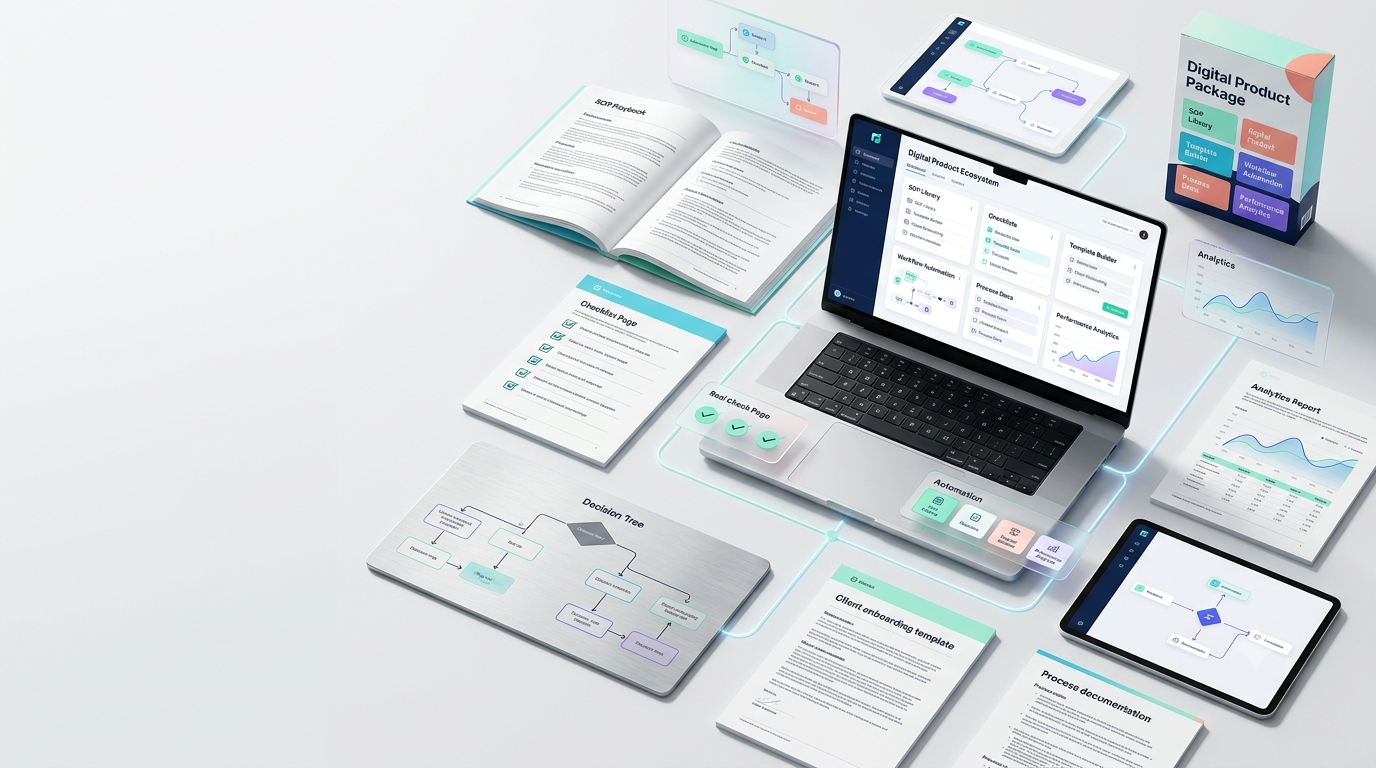
Sell SOP Templates to Solopreneurs (+ $5K–$50K/Month Blueprint)
Running a one-person business sounds simple until you are simultaneously responsible for marketing, sales, customer support, delivery, administration, bookkeeping, content creation, follow-ups, and business development. That is exactly why learning how to sell SOP templates, high-value B2B checklists, and operational playbooks to solopreneurs can become a powerful digital product business model. Instead of selling another generic planner or motivational PDF, you can create business process templates, SOP templates for sale, operational checklists, and operations playbooks that help entrepreneurs complete important business tasks faster, more consistently, and with fewer mistakes.
The opportunity is particularly interesting because AI has made information cheaper but it has not made well-designed execution systems equally cheap.
A solopreneur can ask an AI tool for 50 ideas in seconds. What they still need is a reliable system that tells them:
That difference is where high-value sell SOP templates become commercially interesting.
Google’s current guidance for AI-powered search also reinforces an important principle: content that provides genuinely useful, original, non-commodity information is more valuable than content that merely repeats generic advice.
So the goal of this guide isn’t simply to show you how to make a PDF and upload it to a marketplace.
The goal is to show you how to build a sellable operational asset.
A solopreneur may technically be operating a “small” business, but the number of responsibilities inside that business can be surprisingly large.
Imagine a freelance marketing consultant with 12 active clients.
Every week, that person may need to:
None of these tasks necessarily requires a full-time employee.
But together, they can consume a huge portion of the owner’s week.
And that creates an important business problem:
The more frequently a solopreneur repeats an operational task, the more expensive it becomes to perform that task from memory.
Suppose a business owner spends 30 minutes every Monday figuring out how to qualify new leads.
That’s approximately:
30 minutes × 52 weeks = 26 hours per year.
Now multiply that by ten recurring processes.
Suddenly, the business owner has spent roughly 260 hours repeatedly deciding how to do things that could have been documented once.
This is where an SOP becomes much more than a document.
An SOP, or Standard Operating Procedure, is a documented process that explains how to complete a recurring task consistently.
A useful SOP usually answers:
A checklist is usually narrower.
It helps someone confirm that the necessary actions have been completed.
An SOP, by contrast, can explain the actual operating procedure.
The strongest commercial products combine both.
For example:
→ Trigger: New lead enters CRM
→ Step 1: Check company profile
→ Step 2: Verify decision-maker
→ Step 3: Evaluate budget
→ Step 4: Score business fit
→ Decision: Qualified or unqualified
→ Qualified → Schedule discovery call
→ Unqualified → Add to nurture sequence
→ QA: Confirm CRM fields completed
That is significantly more useful than a generic document titled “10 Lead Generation Tips.”
There is nothing inherently wrong with planners, journals, habit trackers, or printable worksheets.
The problem is economic value perception.
A consumer buying a $9 productivity planner may be purchasing motivation, organization, or inspiration.
A business owner buying a $199 operational system may be purchasing something very different:
time savings + reduced mistakes + repeatability + implementation speed.
That distinction matters.
Inspiration is inexpensive. Implementation has economic value.
Consider two products.
“50 Marketing Ideas for Small Businesses”
“B2B Lead Qualification & Follow-Up SOP System”
Product A provides ideas.
Product B provides an operating procedure.
The second product can potentially command a higher price because the buyer isn’t simply paying for information. They are paying to avoid designing the system themselves.
The original outline captures this positioning difference by contrasting low-priced B2C planners with higher-priced B2B SOP products.
But there is an even more important distinction:
Don’t sell the document. Sell the avoided work.
If a solopreneur could spend six hours researching, designing, testing, formatting, and documenting a workflow or purchase a polished system for $199 the value proposition becomes much easier to understand.
For example:
| Product | Possible Buyer Perception |
| Generic planner | “This will help me organize myself.” |
| Checklist | “This will help me remember the steps.” |
| SOP template | “This gives me the process.” |
| SOP + checklist bundle | “This gives me the process and execution tool.” |
| Complete operations system | “This can become part of how my business runs.” |
That last category is where premium digital products become particularly interesting.
One of the biggest mistakes new digital product sellers make is confusing format with value.
A PDF isn’t valuable because it is a PDF.
A Notion template isn’t valuable simply because it is built in Notion.
A spreadsheet isn’t valuable because it contains 20 tabs.
The value comes from the system encoded inside the asset.
For example, imagine selling a $249 “Client Onboarding SOP.”
If it is simply a five-page document saying:
the buyer may reasonably ask why they should pay $249.
But consider a much deeper system:
Client Onboarding Operations System
Now the buyer isn’t simply receiving information.
They are receiving an operations playbook.
That’s the fundamental mindset shift behind high-value B2B digital products.
The outline identifies five major opportunity categories: marketing operations, e-commerce operations, sales pipeline management, client delivery systems, and hiring/team operations.
Rather than treating the search-volume numbers in the original outline as verified market data, use these categories as commercial opportunity areas and validate actual demand using current keyword research, marketplace demand, competitor pricing, and customer conversations before launching.
Marketing is one of the strongest areas for operational templates because marketing contains many repeatable activities.
Example: LinkedIn Lead Generation SOP
A basic template might contain:
Trigger: Every weekday at 9:00 AM
Now imagine adding:
The product becomes much more defensible.
E-commerce businesses are another natural market because they contain highly repetitive operational workflows.
The opportunity isn’t necessarily in creating a generic “e-commerce checklist.”
The better approach is to solve a specific operational bottleneck.
For example:
Shopify New Product Launch SOP: From Product Upload to First 10 Orders
That title immediately communicates:
This is much stronger than:
“E-Commerce Business Checklist”
The first product is specific enough that the buyer can immediately imagine using it.
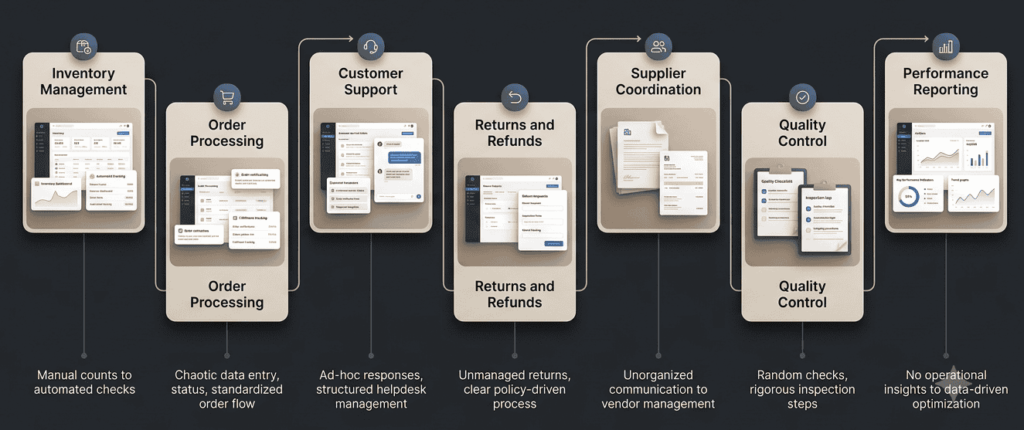
Sales processes are particularly suitable for SOP products because they naturally involve stages, decision points, scripts, and repeatable actions.
Potential products include:
A high-value sales SOP could be structured around the complete pipeline:
Lead → Qualification → Discovery → Proposal → Follow-Up → Negotiation → Close → Handoff
Each stage can have its own checklist and decision criteria.
That creates an opportunity for a Sales Operations Playbook rather than a single checklist.
This category is particularly valuable for consultants, freelancers, agencies, coaches, designers, developers, and other service businesses.
Why?
Because once a service provider gets clients, the next problem is delivering consistently.
Potential products include:
Consider the difference between these two products:
Client Onboarding Checklist
Client Onboarding Operations System for Freelancers
The premium version could contain:
The buyer now receives an entire repeatable process.
A solopreneur doesn’t necessarily remain solo forever.
Eventually, many successful one-person businesses begin outsourcing specific tasks to:
And that creates a new problem:
How do you delegate a task without spending hours explaining it repeatedly?
That’s precisely where SOPs become valuable.
Potential products include:
A good hiring-related SOP should not simply tell someone to “hire a VA.”
It should define the actual process:
Need identified → Job description → Candidate sourcing → Screening → Interview → Test task → Reference check → Contract → Onboarding → First assignment → QA → Review
This is what makes an operational checklist commercially useful.
One of the most powerful ideas in the original outline is the micro-niche angle.
This is where many digital-product creators make a strategic mistake.
They try to create something for everyone.
For example:
“Ultimate Marketing SOP Template”
That sounds broad.
Broad sounds attractive but broad often means generic.
Now narrow it:
“B2B SaaS Lead Qualification SOP”
Narrower.
Or:
“Lead Qualification SOP for Boutique B2B SaaS Agencies”
Even narrower.
Or:
“HubSpot Lead Qualification SOP for Boutique B2B SaaS Agencies”
Now you have a much more specific buyer.
Why specificity can increase perceived value
A general SOP forces the customer to adapt it.
A specialized SOP can feel closer to done-for-you infrastructure.
That’s a major difference.
Consider:
Social Media Marketing Checklist
LinkedIn Content Repurposing SOP for B2B Consultants
The second product immediately communicates:
This specificity can also help your content target long-tail search queries.
Instead of competing for a broad phrase such as:
“SOP template”
you can build topical relevance around phrases such as:
This is much closer to how real customers search for solutions.
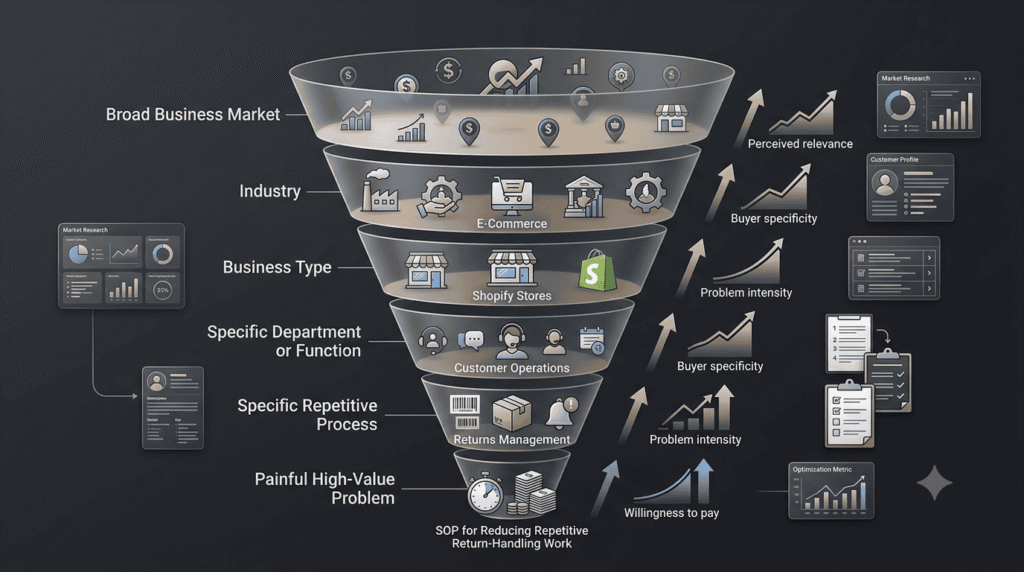
Don’t choose a niche simply because it sounds profitable.
Use a simple five-part validation process.
Look for tasks entrepreneurs perform every week or month.
Examples:
The best opportunities usually involve:
Instead of:
“small businesses”
try:
“freelance web designers”
or:
“B2B SaaS consultants”
or:
“Shopify store owners.”
If people already have a recognizable process, documenting and improving it becomes easier.
This is where you can move from a low-priced template to a higher-value product.
Add:
The result is no longer merely an informational document.
It’s a business process template system.
If you want to learn how to sell high-value B2B checklists and SOPs to solopreneurs, this is arguably the most important section of the entire strategy.
The difference between a $19 template and a $199+ operational product isn’t simply the number of pages.
It is the depth of implementation.
The original outline identifies seven non-negotiable components: trigger condition, prerequisites/tool stack, step-by-step workflow, visual workflow, QA rubric, time/ROI estimate, and troubleshooting FAQ.
Let’s break them down.
Component #1: Define the Trigger Condition
Every good SOP needs a starting point.
Ask:
When exactly should the customer use this SOP?
Weak:
“Use this checklist for lead management.”
Strong:
“Start this SOP every time a new qualified lead enters your CRM.”
That single sentence changes the document from educational material into an operational tool.
Trigger:
A new inbound lead completes the website contact form and enters the CRM.
Process owner:
Sales or business development owner.
Target completion time:
Within 15 minutes during business hours.
Desired outcome:
Lead is qualified, categorized, contacted, and assigned to the correct follow-up sequence.
Now the buyer understands exactly when the system applies.
Component #2: Document Prerequisites and the Tool Stack
Before the process begins, tell the buyer what they need.
For example:
Specify who needs access to:
This is an overlooked way to increase perceived value.
Instead of forcing the buyer to figure out what they need before starting, your SOP provides the setup requirements in advance.
This is the core of your SOP.
Don’t write vague instructions such as:
“Review the lead and decide if they’re qualified.”
Explain how to make that decision.
For example:
Confirm:
Determine whether the contact:
Look for:
Example:
| Criterion | Score |
| Ideal industry | +2 |
| Correct company size | +2 |
| Decision-maker | +2 |
| Immediate need | +2 |
| Budget fit | +2 |
8–10: High-priority lead
5–7: Nurture
0–4: Low-priority
Now your buyer isn’t simply being told what to do.
They’re being given a decision framework.
That is much more valuable.
Decision trees are one of the easiest ways to turn a basic checklist into a more sophisticated operations playbook.
For example:
Does the lead meet ICP criteria?
→ Yes → Continue qualification.
→ No → Move to nurture list.
Does the lead have a defined project?
→ Yes → Schedule discovery call.
→ No → Send educational resource.
Does budget meet minimum threshold?
→ Yes → Continue.
→ No → Offer appropriate lower-tier service or exit process.
This is powerful because real business processes aren’t linear.
They contain exceptions.
Your SOP should account for those exceptions.
A process is incomplete if the user doesn’t know what “good” looks like.
Create a quality-control checklist.
For example:
Lead Qualification QA
Before marking the process complete:
This makes your SOP measurable.
And measurable systems feel much more professional than generic advice.
One of the best ways to explain the economic value of a B2B digital product is to connect the system to time.
Suppose a customer currently spends:
5 hours/week managing a recurring process.
If your system reduces that to:
2 hours/week
the customer potentially reclaims:
3 hours/week × 52 weeks = 156 hours/year.
Now the buyer can evaluate the product based on business economics rather than page count.
For example, if the customer’s effective value of time is $50/hour:
156 × $50 = $7,800 of potential annual time value.
That doesn’t mean your SOP “creates $7,800” or guarantees that result.
It simply gives the buyer a framework for evaluating potential ROI.
That distinction is important for ethical marketing.
This is where an ordinary SOP becomes significantly more useful.
Ask:
What will probably go wrong when someone uses this?
Then document the answer.
For example:
Problem: The client hasn’t submitted the intake form.
Solution: Send the automated reminder after 24 hours. If no response occurs after 72 hours, send a personal follow-up.
Problem: The lead doesn’t provide a budget.
Solution: Use the approved budget-discovery question from the sales script rather than guessing.
Problem: The customer requests a task outside the agreed scope.
Solution: Check the scope-control procedure before approving additional work.
These troubleshooting sections can dramatically reduce customer confusion and potentially reduce the amount of support you need to provide after the sale.
Your final product should not feel like someone copied a blog post into Canva.
It should look like something a business would actually use.
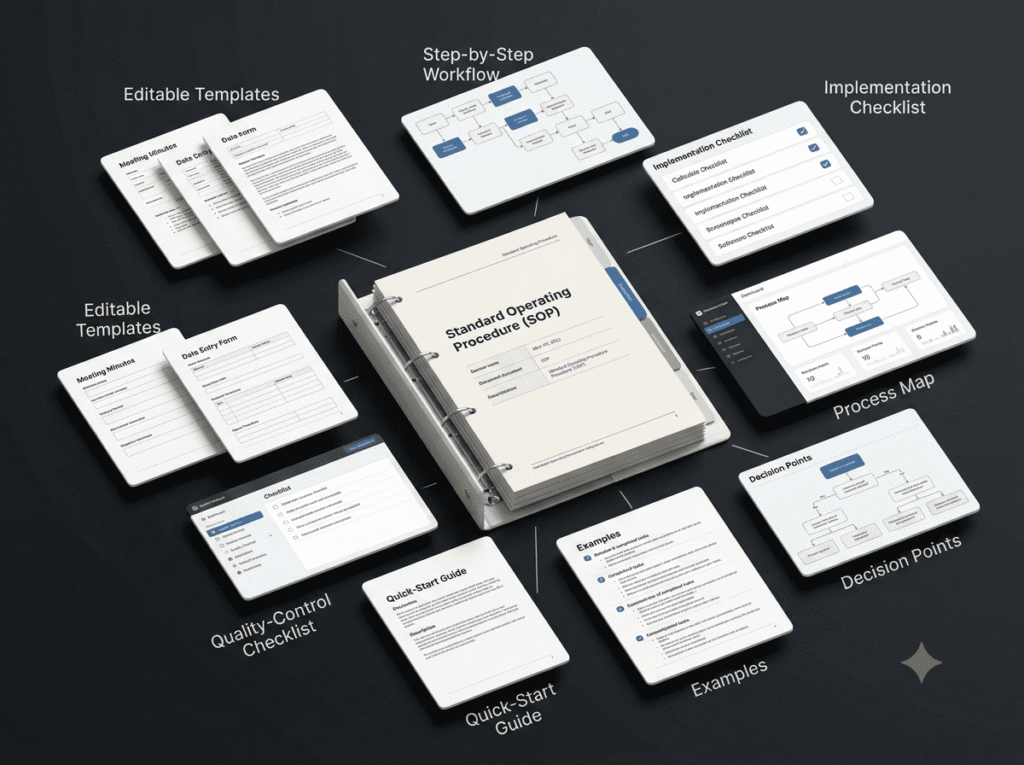
Consider including:
Core document
Implementation tools
Templates
Visual resources
Training
For premium products, consider:
The original outline similarly recommends professional formatting, customization, video walkthroughs, and supporting tools as ways to strengthen premium positioning.
A useful way to think about your product is:
SOP + Checklist + Templates + Decision Tree + QA + Examples + Implementation = High-Value Operations System
For example:
$19 product
Lead Qualification Checklist
$49 product
Lead Qualification SOP
$99 product
Lead Qualification SOP + Checklist + Scripts
$199 product
Complete Lead Qualification Operations System
Includes:
$299+ product
Complete System + Video Implementation + Bonus Templates + Advanced Workflows
This is the fundamental product ladder behind a high-value digital product business.
You aren’t necessarily charging more because you added 100 pages.
You’re charging more because you removed more work.
If you remember only one idea from this first part, remember this:
Don’t build a digital product that merely tells solopreneurs what they should do. Build a system that helps them actually do it.
That’s the difference between information and infrastructure.
A generic checklist says:
“Remember to follow up with leads.”
A high-value SOP says:
“When a lead enters your CRM, perform these seven actions, use this qualification framework, follow this decision tree, send this message, record these fields, and verify these completion criteria.”
The second product has operational utility.
And operational utility is what creates the possibility of premium pricing.
Once you have created a professional SOP, checklist, operations playbook, or business process template, you need somewhere to sell and deliver it.
This decision matters because the platform becomes part of the customer experience.
A buyer doesn’t only evaluate your PDF.
They also experience:
A great SOP delivered through a confusing buying experience can lose sales.
Your objective should therefore be:
Make buying and implementing the product feel almost as easy as using the product itself.
Your original outline compares Gumroad, Notion Marketplace, Stan Store, and course platforms such as Kajabi and Teachable.
However, platform pricing and features change frequently. Treat the figures in the outline as planning assumptions rather than permanent prices, and verify current fees before publishing a comparison table on your website.
Gumroad is attractive to creators who want a relatively straightforward way to sell downloadable products.
It can make sense when your product is primarily:
Example
Suppose you create:
“The Complete Client Onboarding SOP Kit”
It contains:
A simple digital storefront can deliver those assets immediately after purchase.
The advantage
You don’t necessarily need to build a sophisticated website before testing your product.
That matters when you’re validating demand.
Your first objective shouldn’t necessarily be:
“Build the perfect digital product company.”
It should be:
“Prove that a specific customer will pay for a specific operational solution.”
Once you have sales, you can expand the ecosystem.
Notion can be particularly useful when your SOP isn’t just a document but an interactive workspace.
For example, imagine selling:
“Freelancer Client Operations Hub”
Instead of giving the customer one PDF, you could provide:
Dashboard
Client Operations
→ New Client
→ Active Projects
→ Client Communication
→ Delivery Checklist
→ Feedback
→ Offboarding
Inside the dashboard:
New Client
This transforms your product from a static document into a reusable operational environment.
That can dramatically improve perceived usefulness.
Stan Store is designed around creator storefronts and selling digital offers.
This type of platform can be attractive if your business strategy relies heavily on:
For example, your social profile could lead visitors toward:
Free Lead Qualification Checklist
↓
$49 Lead Qualification SOP
↓
$199 Sales Operations Bundle
↓
$499 Complete Sales System
The important idea is that your storefront isn’t simply a place where products sit.
It can become part of the customer acquisition funnel.
Kajabi and Teachable become more relevant when you’re selling something larger than a simple template.
For example:
“Build Your Complete Client Delivery System”
Instead of providing only a PDF, you could create:
Module 1
Client onboarding
Module 2
Project management
Module 3
Communication
Module 4
Quality control
Module 5
Feedback
Module 6
Offboarding
Module 7
Automation
Now the customer is purchasing both:
System + Education
That creates a natural path toward higher-ticket products.
Instead of asking:
“Which platform is best?”
ask:
“What does my customer need to receive?”
| Product Type | Appropriate Delivery Approach |
| Single PDF checklist | Simple digital download |
| SOP + templates | Digital storefront |
| Notion-based operating system | Notion workspace |
| SOP bundle | Digital product platform |
| SOP + video training | Course platform |
| Complete implementation program | Course + community/coaching |
| Custom SOP implementation | Service + digital product |
The mistake is choosing the technology before defining the product.
Product first. Platform second.
If you’re selling high-value digital products, delivery security deserves attention.
The more valuable your product becomes, the more important it is to consider:
Your original outline specifically calls out password protection, time-limited download links, and automated delivery emails as security/access considerations.
You don’t need to turn a $99 SOP into a bank vault.
But you should make unauthorized sharing inconvenient and legitimate customers’ access easy.
The customer journey shouldn’t end at checkout.
A strong delivery sequence can look like this:
Step 1: Purchase
Customer completes checkout.
Step 2: Confirmation
They immediately receive confirmation.
Step 3: Access
The customer receives access instructions.
Step 4: Quick Start
Give them a short “Start Here” document.
Step 5: Implementation
Show them exactly what to do first.
Step 6: Support
Provide FAQs and troubleshooting.
Step 7: Follow-up
Send an email asking whether implementation has begun.
Step 8: Upsell
Offer a complementary product when appropriate.
That final step is particularly important.
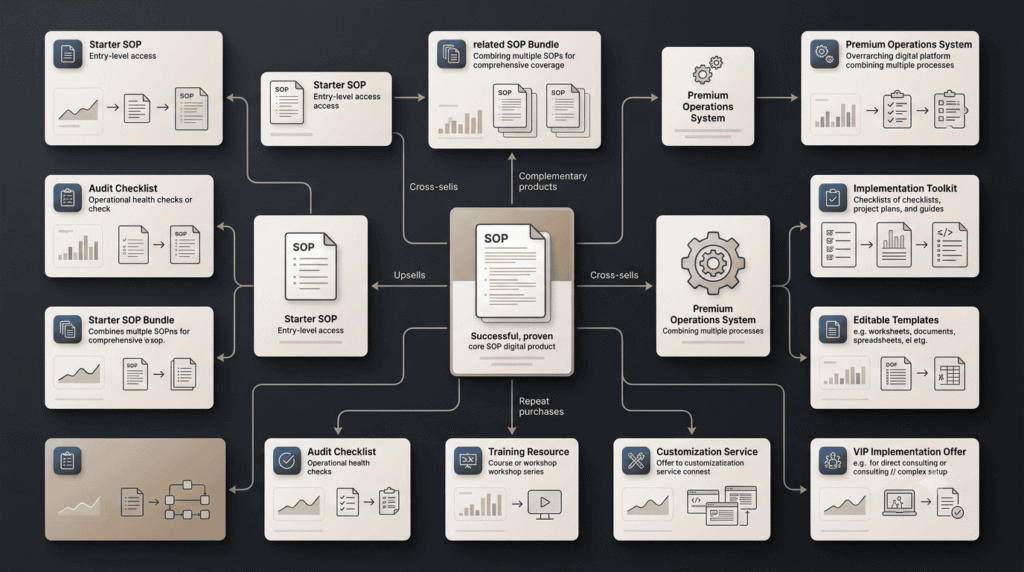
If someone buys a Lead Qualification SOP, their next logical purchase might be:
Sales Follow-Up SOP
Then:
Proposal SOP
Then:
Client Onboarding SOP
You’ve just created a product ecosystem.
One of the strongest concepts in your outline is the price ladder strategy.
Instead of selling everything for one price, create several levels of transformation.
Here’s the model:
Level 1 Free Resource
$0
Example:
“5-Step Lead Qualification Checklist”
Purpose:
Generate leads.
Level 2 Starter Product
$49–$99
Example:
“Lead Qualification SOP Template”
Purpose:
Convert leads into first-time buyers.
Level 3 Bundle
$199–$299
Example:
“Complete B2B Sales SOP Bundle”
Includes:
Purpose:
Increase average order value.
Level 4 Premium System
$399–$499
Example:
“Complete Sales Operations System”
Includes:
Purpose:
Sell a more complete transformation.
Level 5 VIP Implementation
$1,500–$3,000
This is no longer purely a digital product.
It might include:
Purpose:
Monetize customers who want speed and personalization.
The price ladder solves a psychological problem.
A new visitor may not be ready to spend $499 with you.
But they may be willing to download something free.
After experiencing your expertise, they may become comfortable spending $49.
After getting results from the $49 product, the $199 bundle becomes easier to justify.
Then the $499 product becomes the logical next step.
This creates a progression:
Trust → Trial → Result → Expansion → Premium implementation
That’s far more sophisticated than:
“Here’s my $299 PDF. Buy it.”
Your outline recommends the free-first funnel as the primary selling method.
This strategy is particularly useful for a new digital product business without a large audience.
Here’s the basic structure:
Free resource

Email signup
Helpful educational content
Paid SOP
Bundle
Premium system
The free resource should not be random.
It should be the smaller version of the paid solution.
Suppose you’re selling:
$199 B2B Lead Qualification SOP System
Your free lead magnet could be:
“5-Step B2B Lead Qualification Checklist”
Notice what happened.
The free product solves part of the problem.
The paid product solves the entire problem.
That is the ideal relationship.
Your free resource therefore creates a natural question:
“How do I implement the rest?”
Your paid product answers it.
Your outline gives an excellent example of testing a functional title against a benefit-driven title.
For example:
5-Step Lead Qualification Checklist
◉ How to Qualify 10x More Leads in 30 Minutes
The second headline is more benefit-oriented.
However, there is an important SEO and trust consideration:
◉ Don’t promise “10x” unless you can substantiate it.
A safer version could be:
◉ How to Qualify B2B Leads Faster Using a 5-Step Process
This maintains the benefit while avoiding an unsupported numerical promise.
One of the most useful sales mechanisms for B2B products is alternative-cost framing.
Instead of saying:
“This template costs $199.”
you can explain:
“What would it cost to build this internally?”
Suppose a business owner would otherwise need:
That’s 8 hours.
If their effective time value is $75/hour:
8 × $75 = $600
A $199 product can then be positioned as a shortcut.
But be careful:
Don’t claim:
“Our $199 SOP saves every buyer $600.”
Instead say:
“If building this system yourself takes eight hours, a $199 template could be an economical alternative for someone who values their time at $75/hour.”
That’s credible value framing.
There’s another comparison that’s often even more powerful.
What happens if the customer doesn’t solve the problem?
Suppose an agency repeatedly loses qualified leads because follow-ups are inconsistent.
The cost isn’t simply:
“They don’t have an SOP.”
The cost could be:
This gives you a stronger sales argument:
The cost of a system should be compared not only with the price of the system, but also with the cost of continuing without one.
That is classic B2B value positioning.
The outline recommends testimonials, usage claims, and quantified outcomes as social proof.
The principle is sound, but there’s one crucial rule:
Never invent testimonials, customer counts, or performance statistics.
If
◉ 500 people have genuinely used your product, say so.
◉ If three customers have used it, say three.
◉ If you don’t have testimonials yet, don’t fabricate them.
Instead, use:
Early-stage creators often think they need fake social proof.
They don’t.
They need evidence of competence.
A weak testimonial:
“Great template! Highly recommend.”
A stronger testimonial:
“Before using the onboarding SOP, I was manually checking every client setup. The checklist gave me a repeatable process and made it easier to hand the task to my VA.”
The second one explains:
Before → Product → After
That’s much more persuasive.
Encourage customers to describe:
A high-converting product page doesn’t need to begin with:
“Welcome to my amazing SOP template!”
Instead, begin with the problem.
For example:
◉ Headline
Stop Rebuilding Your Client Onboarding Process Every Time You Get a New Client
◉ Problem
You’re answering the same questions, sending the same emails, collecting the same information, and manually checking the same steps.
◉ Solution
The Client Onboarding Operations System
A ready-to-customize workflow containing the SOP, checklists, templates, and QA process required to onboard clients consistently.
What’s Included
Who It’s For
Who It’s Not For
That final section can actually improve trust.
A premium product should not pretend to be universal.
Specificity increases relevance.
For example:
This SOP is for:
This SOP is not designed for:
The buyer can quickly self-qualify.
That reduces refund risk and customer frustration.
Your original outline provides three primary methods: free-first funnel, comparison positioning, and social proof.
You don’t have to choose only one.
A stronger system combines all three.
Give value → collect email → nurture → sell
Show what DIY or hiring costs → position product as shortcut
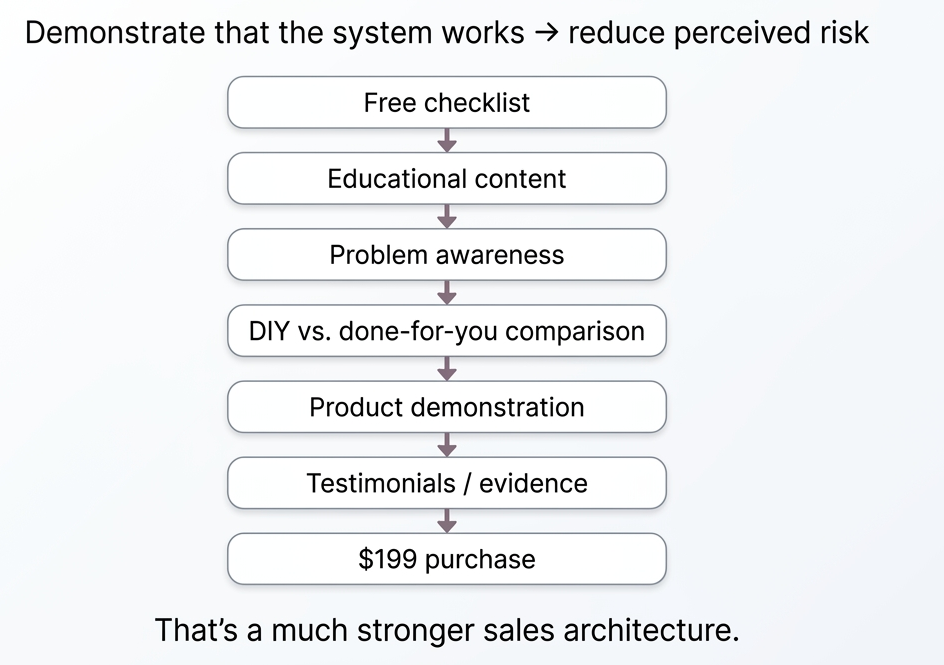
Demonstrate that the system works → reduce perceived risk
Combined:
Free checklist
A visitor who downloads your free checklist doesn’t necessarily want your paid product immediately.
That’s normal.
The original outline notes email nurture as an important monetization element.
Instead of aggressively selling every day, create a short educational sequence.
Email 1 Deliver the Resource
◉ Subject concept:
Your Lead Qualification Checklist
Give them the promised asset.
Explain how to use it.
Email 2 Explain the Problem
Explain why inconsistent qualification creates operational problems.
Teach something useful.
Email 3 Show the Missing Layer
Explain why a checklist alone isn’t enough.
Introduce:
Email 4 Demonstrate the System
Show how the complete SOP works.
Use screenshots or examples.
Email 5 Present the Paid Product
Introduce the full system.
Explain:
This sequence turns the email list into an educational asset rather than simply a promotional channel.
Imagine two product descriptions.
◉ Description A
“PDF containing 32 pages of SOP instructions.”
Versus:
◉ Description B
“A ready-to-customize client onboarding system that helps you standardize the process from signed contract to kickoff.”
Which sounds more valuable?
Obviously, B.
The customer isn’t buying 32 pages.
They’re buying the possibility of a more organized workflow.
That distinction should influence:
The original outline specifically includes a mistake-avoidance section covering complexity, underpricing, lack of customization, weak niche specificity, and inadequate follow-up.
Let’s turn each into a practical lesson.
More pages don’t automatically equal more value.
If the customer opens your product and sees 80 pages of dense text, they may think:
“When am I supposed to read all this?”
Instead, optimize for implementation speed.
Use:
The buyer should be able to scan the document and immediately understand where to start.
Your outline warns against $9–$19 templates.
The underlying principle is not that low-priced products can never sell.
They can.
The issue is misalignment between price and positioning.
If you’re selling a highly specialized B2B operational system that can save substantial time, $9 may communicate:
“This is a simple downloadable template.”
That may not match the product’s actual value.
Instead, price according to:
Compare:
◉ Generic:
Marketing SOP Template
with:
◉ Specific:
B2B SaaS Content Repurposing SOP for LinkedIn
The second one is easier to market.
◉ You know:
Specificity creates a marketing advantage.
A template should give the customer a starting point.
Allow them to customize:
This makes a product feel like their system, rather than your document.
One of the biggest digital-product mistakes is assuming:
Download = purchase intent = sale.
Not necessarily.
A visitor may:
That’s why email nurturing matters.
Your audience needs repeated exposure to:
Problem → Solution → Evidence → Offer
without becoming spammy.
Your article title includes a $5K–$50K/month blueprint, but this should be presented as a business-model framework not a guaranteed income claim. The original outline itself uses example revenue milestones, including a path from $297 in Month 1 to $15K/month in Month 6.
The math is straightforward.
💵At $99:
51 sales × $99 = $5,049
💵💵At $199:
26 sales × $199 = $5,174
💵💵💵At $299:
17 sales × $299 = $5,083
Notice what happens.
The higher the average order value, the fewer transactions you need.
💵At $99:
152 sales × $99 = $15,048
💵💵At $299:
51 sales × $299 = $15,249
💵💵💵At $499:
31 sales × $499 = $15,469
Again, the point isn’t that $499 is automatically better.
The point is that product economics matter.
At $50,000/month, relying on one $49 template would require:
1,021 sales × $49 = $50,029
That’s a significant volume requirement.
At $299:
168 sales × $299 = $50,232
At $499:
101 sales × $499 = $50,399
And a mixed product ecosystem could look very different.
For example:
Total = $50,260
This is why the goal shouldn’t simply be:
“Sell more templates.”
Instead:
Build an ecosystem with multiple levels of customer value.
A sustainable digital product business can have:
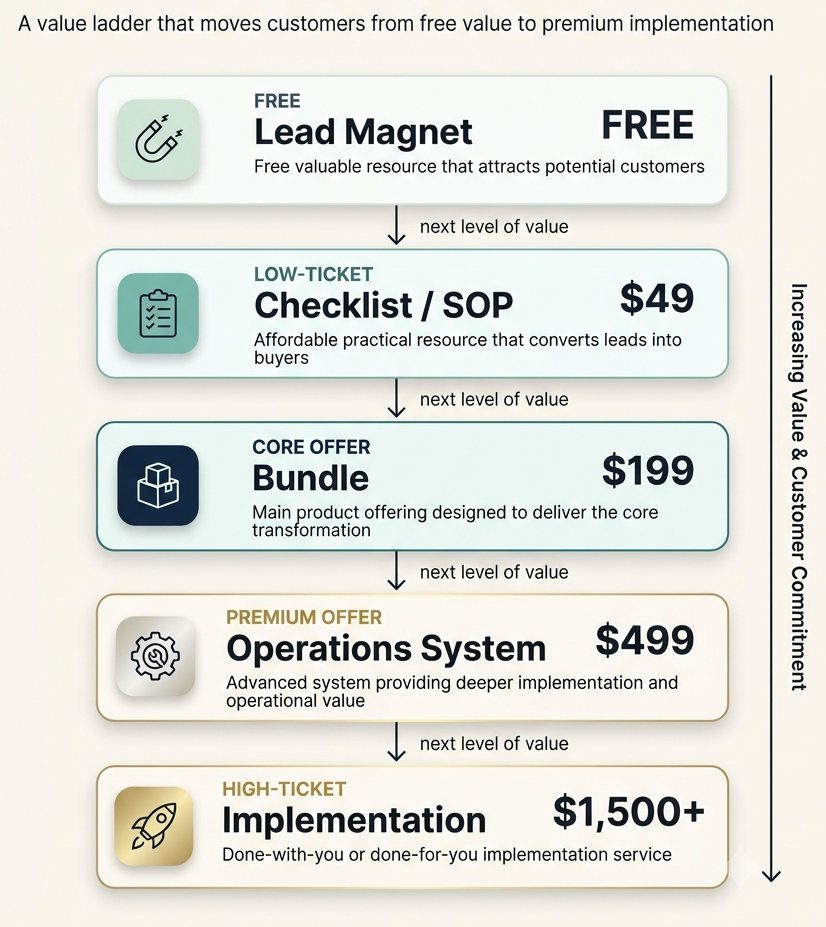
This gives you multiple ways to monetize the same customer.
And notice something important:
You don’t need five completely unrelated businesses.
You can build the entire ladder around one operational problem.
For example:
Client onboarding
Free:
Client Onboarding Checklist
💵 $49:
Client Onboarding SOP
💵💵 $199:
Client Onboarding SOP Bundle
💵💵💵 $499:
Complete Client Delivery Operations System
💵💵💵💵 $1,500:
Custom Client Onboarding Implementation
One problem.
Five monetization levels.
The most important lesson isn’t a particular platform, price, or sales tactic.
It’s this:
𝟏st Stage: Identify a recurring business problem
𝟐nd Stage: Build a specialized SOP
𝟑rd Stage: Add implementation tools
𝟒th Stage: Create a free entry point
𝟓th Stage: Build an email audience
𝟔th Stage: Sell the core product
𝟕th Stage: Bundle related SOPs
𝟖th Stage: Add premium implementation
𝟗th Stage: Automate delivery
𝟏𝟎th Stage: Scale acquisition
That’s the business model.
AI changes the economics of creating digital products.
You can use AI to accelerate:
But there’s an important limitation:
AI-generated information isn’t automatically a valuable SOP.
If your product is essentially:
“AI-generated generic marketing advice”
you may struggle to justify a premium price.
Instead, use AI as a production accelerator while the actual product is based on:
That creates differentiation.
The original outline calls for “SEO & AI Optimization,” including FAQ schema, table schema, video, internal links, keyword placement, semantic terms, and mobile UX.
Those are useful components, but don’t confuse structured markup with a ranking shortcut.
Google’s current documentation says AI features such as AI Overviews and AI Mode use the same foundational SEO requirements as ordinary Search. There is no additional special schema or “AI text file” required to appear in those features.
That means your article should be structured so that both humans and search systems can understand it easily.
Use:
The goal is retrievable expertise, not keyword repetition.
Your primary keyword is:
how to sell high-value B2B checklists and SOPs to solopreneurs
It should appear naturally in:
Your semantic keyword group can include:
These variations help establish topical relevance without repeating one phrase unnaturally.
Suppose you wrote:
“Our high-value B2B checklists and SOPs to solopreneurs are the best high-value B2B checklists and SOPs for solopreneurs who want high-value B2B checklists and SOPs…”
That’s obviously terrible.
The reader doesn’t need to see the exact keyword 50 times.
They need to understand the subject deeply.
A better approach is semantic coverage.
For example:
A consultant can use a client onboarding SOP to standardize recurring tasks. That SOP can become part of a broader operations playbook containing business process templates, checklists, scripts, and QA procedures.
Search engines understand the relationship among those concepts.
And humans actually enjoy reading it.
Another mistake is becoming obsessed with tools.
You might spend weeks comparing:
Meanwhile, you haven’t validated whether anyone wants the SOP.
Don’t do that.
A better sequence is:
Problem → Audience → Product → Validation → Sales → Technology → Automation
Not:
Technology → Website → Logo → Brand colors → Product → Maybe sales
The first sequence gets you to market faster.
If you are starting from zero, you don’t need a massive technology stack.
A minimal setup can consist of:
Product
One highly specific SOP.
Lead magnet
One useful free checklist.
Sales page
One focused product page.
A short nurture sequence.
Delivery
Automated digital delivery.
Traffic
One primary channel.
Analytics
Track:
That’s enough to begin learning.
Don’t judge the business only by revenue.
Track the entire funnel.
Traffic
How many people visit?
Lead conversion
How many visitors become email subscribers?
Lead Conversion Rate = Leads ÷ Visitors × 100
Sales conversion
How many visitors purchase?
Sales Conversion Rate = Customers ÷ Visitors × 100
Average order value
AOV = Revenue ÷ Number of Orders
Revenue per visitor
RPV = Revenue ÷ Visitors
These metrics tell you where the problem is.
For example:
High traffic + low opt-ins
→ Lead magnet problem.
High opt-ins + low sales
→ Offer or nurture problem.
Good sales + low AOV
→ Product ladder problem.
High AOV + low traffic
→ Acquisition problem.
This is far more actionable than simply checking your monthly revenue.
Don’t immediately obsess over $50K/month.
Start with a smaller question:
Can I get five strangers to pay for this?
Then:
Can I get ten?
Then:
Can I sell it repeatedly without personally explaining it to every customer?
Then:
Can another person implement the SOP successfully?
Then:
Can I acquire customers predictably?
This progression matters.
Revenue is the outcome.
Repeatable demand is the asset.
At this point, the business model should look much clearer.
You start with a recurring operational problem.
and You create a specialized SOP.
You add:
Then you package the solution at different levels.
Your ecosystem can look like:
Free checklist
💵 $49–$99 SOP
💵💵 $199–$299 bundle
💵💵💵 $399–$499 complete system
💵💵💵💵 $1,500–$3,000 implementation
The original outline’s price ladder follows essentially this structure.
The key is to make each level deliver a larger transformation, rather than simply adding more pages.
Let’s build a realistic composite example rather than pretending that one person’s results are universal.
Imagine a creator named Sarah.
Sarah has experience in client operations and decides to build a digital product business around client onboarding systems for freelancers and small agencies.
Her first product is:
Client Onboarding SOP & Checklist System
It contains:
She doesn’t start with ten products.
She starts with one.
Month 1: Validate the First Product
Sarah creates a $99 product.
Suppose she makes:
3 sales × $99 = $297
That’s not a life-changing amount of revenue.
But it’s extremely useful information.
Why?
Because she now knows:
At least three people were willing to pay for this solution.
She can ask those buyers:
Those answers become market research.
Your first sales don’t only generate revenue.
They generate customer intelligence.
This is where many creators go wrong.
They sell three copies and immediately think:
“I need five more products.”
Not necessarily.
First improve the existing product.
Look at:
Then update the SOP.
This creates version 2.
You can even communicate:
Version 2.0 now includes a new client intake workflow, implementation checklist, and expanded troubleshooting section.
Product updates can become another reason to stay connected with your customers.
Once Sarah understands what customers want, she creates related products.
For example:
Product #1
Client Onboarding SOP $99
Product #2
Client Communication SOP $99
Product #3
Client Offboarding SOP $99
Instead of forcing customers to purchase all three separately, Sarah creates:
Client Operations Bundle $249
Suppose she sells:
15 bundles × $249 = $3,735
That’s a major improvement over selling only the original $99 product.
The lesson isn’t simply “raise your price.”
The lesson is:
Increase the amount of useful transformation you deliver per customer.
Sarah now has:
She builds a simple sequence.
Lead magnet
Client Onboarding Checklist
Email 1
How to use the checklist
Email 2
Five common onboarding mistakes
Email 3
Why checklists alone don’t create consistent delivery
Email 4
Introduction to the complete onboarding SOP
Email 5
Bundle offer
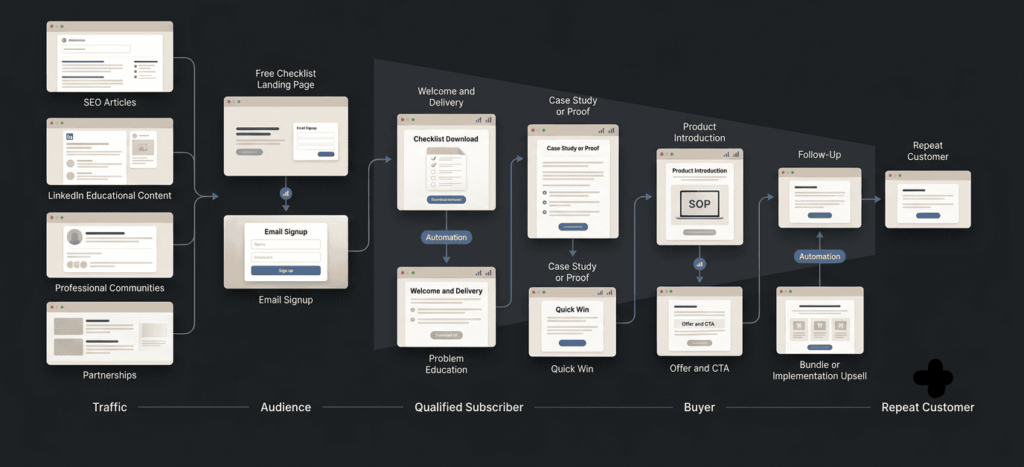
Now sales aren’t entirely dependent on Sarah manually posting about the product every day.
The funnel can continue educating new subscribers.
Sarah notices that some customers don’t simply want templates.
They want help implementing them.
So she introduces:
Client Operations System $499
Includes:
Now Sarah has three customer segments:
Budget-conscious buyers
Buy the $99 SOP templates.
Buyers who want more
Buy the $249 bundle.
Buyers who want the complete system
Buy the $499 premium offer.
That’s segmentation.
Sarah discovers that some customers want her to customize the system.
She creates:
VIP Implementation $1,500+
Possible deliverables:
At this point, the business is no longer simply selling PDFs.
It has become a productized knowledge business.
The digital products generate scalable revenue.
The premium implementation service generates higher revenue per customer.
The two can support each other.
Your original outline specifically suggests hiring a VA as part of the growth journey.
The purpose shouldn’t be to hire someone simply because the business feels successful.
Hire when repetitive tasks are consuming time that should be spent on higher-value activities.
A VA could potentially handle:
Your job then moves toward:
That is leverage.
There is a difference between outsourcing administration and outsourcing the reason customers buy from you.
If your competitive advantage is your expertise in:
B2B sales operations
don’t immediately outsource the actual methodology.
Instead, document your methodology.
Then delegate the repeatable implementation work.
That creates a useful progression:
Expert knowledge
Documented process
SOP
SOP Template
Product
Delegated fulfillment
Scalable business
This is one of the most powerful concepts in the entire model.
Let’s make the mathematics transparent.
Scenario A Lower-priced offer
At $99:
51 sales × $99 = $5,049
You need approximately 51 monthly transactions.
Scenario B Core offer
At $199:
26 sales × $199 = $5,174
You need approximately 26 monthly transactions.
Scenario C Premium product
At $499:
11 sales × $499 = $5,489
You need approximately 11 monthly transactions.
None of these scenarios is “easy.”
But they demonstrate why high-value B2B products can be attractive.
You don’t necessarily need thousands of customers.
You need:
The right audience + strong problem + valuable solution + effective distribution.
At $50K/month, the business generally needs more than one acquisition channel or one product.
Consider a hypothetical mix:
| Offer | Monthly Sales | Price | Revenue |
| Starter SOP template | 100 | $49 | $4,900 |
| Core Bundle | 80 | $199 | $15,920 |
| Premium System | 40 | $299 | $11,960 |
| Advanced System | 20 | $499 | $9,980 |
| VIP Implementation | 5 | $1,500 | $7,500 |
| Total | $50,260 |
Again, this is illustrative math, not a forecast.
The important insight is that a $50K/month business doesn’t necessarily require one viral product.
It can be built from several connected offers.
Once you have one successful SOP, look horizontally.
Ask:
What other problems happen immediately before and after this process?
Suppose you sell:
Client Onboarding SOP
What happens before onboarding?
Sales → Proposal → Contract → Payment
What happens after onboarding?
Delivery → Feedback → Reporting → Offboarding → Testimonial → Retention
Suddenly, one product can become an entire product ecosystem.
You can sell each separately or package them into a complete Client Operations Playbook.
You don’t necessarily need to target 20 audiences.
A more manageable approach is:
One audience + multiple related problems.
For example:
Audience: Freelance web designers
You’ve built a small digital product business around one audience.
That can be much easier to market than eight unrelated products for eight unrelated audiences.
You don’t need six months to create your first test product.
You can create a lean version in one week.
Choose one specific recurring process.
Use this formula:
Audience + Problem + Process + Desired Outcome
For example:
“Client onboarding SOP for freelance designers who want a consistent process from contract signing to project kickoff.”
Much better than:
“Freelancing SOP.”
Study competing products.
Look at:
Don’t copy them.
Find gaps.
For example, competitors might provide:
SOP only
while you can provide:
SOP + templates + tracker + QA + video walkthrough.
That’s differentiation.
Before writing the final document, create the skeleton.
SOP structure
This is much faster than opening a blank document and trying to write randomly.
Now build the implementation tools.
Depending on the process, create:
This is where your product begins to feel like a system.
Your sales page should answer seven questions quickly:
1. What is it?
A client onboarding operations system.
2. Who is it for?
Freelancers, consultants, agencies, and service providers.
3. What problem does it solve?
Inconsistent, repetitive onboarding.
4. What’s included?
List the actual assets.
5. What does it help the buyer accomplish?
Standardize and simplify the process.
6. Why trust you?
Show experience, evidence, demonstrations, or transparent background.
7. What should they do next?
Purchase or download the relevant resource.
Don’t build a completely separate resource.
Extract a smaller part of your paid product.
For example:
The free version gives genuine value.
The paid version provides the complete implementation system.
Publish the product.
Then start distribution.
Track:
Don’t obsess over perfection.
Your first version is an experiment.
Your outline recommends using LinkedIn, communities, email, and affiliate opportunities as traffic multipliers.
You don’t need to attack every channel simultaneously.
Pick one primary audience acquisition channel.
For B2B solopreneur products, LinkedIn can be particularly relevant because the audience naturally includes consultants, freelancers, founders, agency owners, and other professionals.
Don’t constantly post:
“Buy my SOP!”
Instead, teach the problem your SOP solves.
Post idea #1
3 onboarding mistakes that make freelancers look unprofessional
Post idea #2
The 7-step client onboarding workflow I would use if I started a freelance business today
Post idea #3
Checklist vs. SOP: What’s the difference?
Post idea #4
I turned my repetitive client onboarding process into a one-page workflow
Post idea #5
What should happen immediately after a client signs a contract?
At the end:
“I created a free checklist covering the process.”
That’s a much more natural CTA.
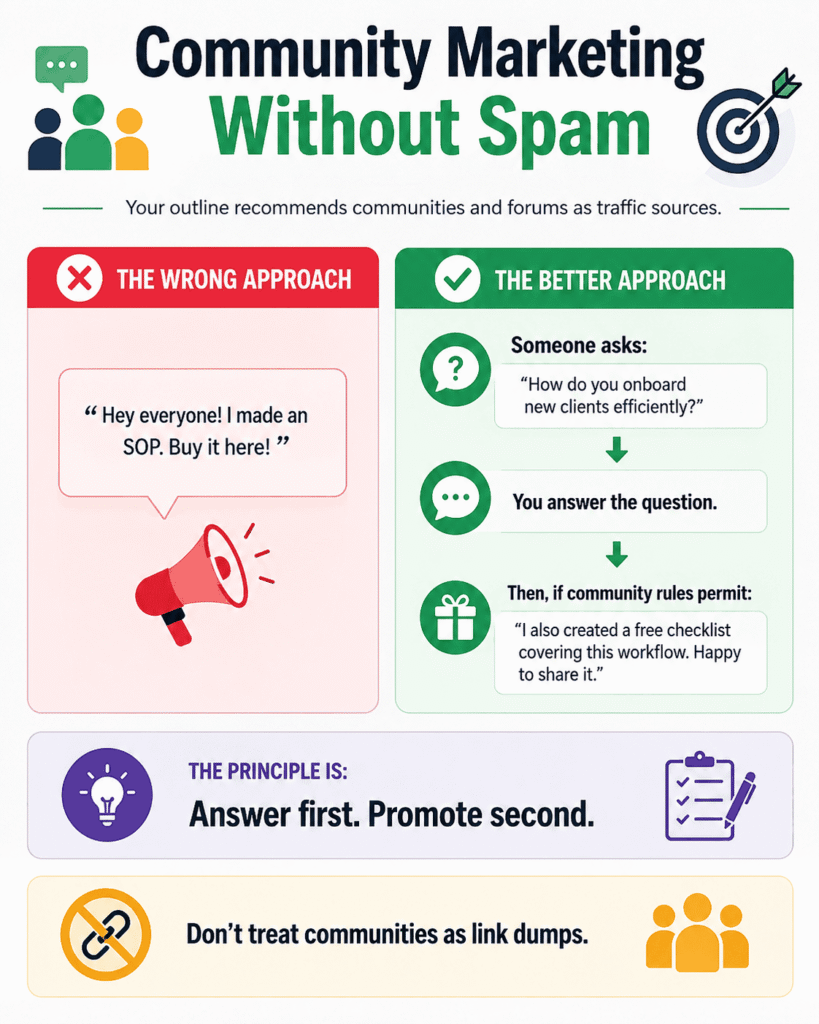
Your outline recommends communities and forums as traffic sources.
The wrong approach:
“Hey everyone! I made an SOP. Buy it here!”
The better approach:
Someone asks:
“How do you onboard new clients efficiently?”
You answer the question.
Then, if community rules permit:
“I also created a free checklist covering this workflow. Happy to share it.”
The principle is:
Answer first. Promote second.
Don’t treat communities as link dumps.
Your email list becomes increasingly valuable as your product catalog grows.
Imagine someone initially downloads:
Client Onboarding Checklist
Later, you can introduce:
One subscriber can potentially become a customer multiple times.
That is why email isn’t simply a marketing channel.
It’s a customer relationship asset.
Affiliate marketing can be useful when other creators serve the same audience.
Potential partners could include:
For example:
A creator teaches freelancers how to build agencies.
Your product provides:
Agency Client Onboarding SOP
The audiences overlap.
You can potentially offer the partner an affiliate commission for qualified sales.
But make sure your affiliate arrangement is transparent and complies with applicable advertising and platform rules.
Your product shouldn’t be the only page optimized for search.
Build supporting educational content around the problem.
For example, if you sell a client onboarding SOP template, create articles such as:
Then internally connect those articles to your main product.
This creates a topic cluster.
Your educational content attracts search traffic.
Your product page monetizes relevant visitors.
Your outline explicitly recommends internal links to related content such as digital-product pricing and email funnels.
For this article, a logical internal-link architecture could include future or existing articles on:
Don’t force links.
Link where the reader naturally needs additional information.
Now we reach one of the most important sections for MakeMoneyOnline.com.
The phrase “AI Search friendly” is useful as a goal, but it shouldn’t be interpreted as a secret optimization formula.
Google’s current guidance is very clear: its AI Overviews and AI Mode use the same foundational SEO systems, and there are no special AI-only technical requirements or special schema types needed to appear. Pages still need to be indexed and eligible for normal Search, while useful, original, people-first content remains foundational.
That means the best strategy is:
Strong SEO + strong information architecture + original expertise + direct answers + crawlable content.
Your primary keyword is:
how to sell high-value B2B checklists and SOPs to solopreneurs
Use it naturally in:
H1
How to Sell High-Value B2B Checklists and SOPs to Solopreneurs
Introduction
Already used in the first paragraph.
H2
Use a close or exact variation where it genuinely fits.
For example:
How to Sell High-Value B2B Checklists and SOPs to Solopreneurs: The Product Model
Meta description
Use it naturally rather than stuffing it.
Body copy
Use the exact phrase occasionally, then rely heavily on related terminology.
Search engines don’t need you to repeat one phrase endlessly.
Cover the broader topic.
Primary keyword
how to sell high-value B2B checklists and SOPs to solopreneurs
Secondary keywords
Long-tail keywords
The goal is comprehensive topical coverage.
AI-powered search systems may retrieve relevant passages from your page to help answer user questions.
So write direct answers.
For example:
What is an SOP?
An SOP, or Standard Operating Procedure, is a documented set of instructions that explains how to perform a recurring business process consistently.
That’s immediately understandable.
Then expand with examples.
Don’t bury the definition inside 600 words of introduction.
Google says AI features can use multiple related searches and supporting pages to construct responses, which makes clear topical coverage and useful supporting content increasingly important.
Tables are particularly useful for decision-oriented searches.
For example:
| Product | Typical Positioning | Buyer |
| Checklist | Quick execution aid | Beginner |
| SOP | Repeatable process | Solopreneur |
| SOP bundle | Multiple workflows | Growing business |
| Operations system | Complete workflow | Advanced buyer |
| Implementation service | Customized execution | High-ticket buyer |
The table should summarize information already explained on the page.
Don’t use tables simply to cram keywords into a page.
The FAQ section should answer genuine questions.
Don’t add questions merely because they contain keywords.
A strong FAQ might include:
We’ll answer these below.
Avoid claims such as:
“Use this schema and Google AI will rank your article.”
That’s not how Google’s current guidance works.
Google specifically says structured data does not guarantee a rich result, and it must accurately represent visible page content.
Likewise, Google says there is no special schema required specifically for AI Overviews or AI Mode.
So your implementation should focus on:
For this article, your technical team may consider appropriate structured data such as:
If the FAQ content qualifies for a supported Google search feature, use the relevant structured data according to Google’s current documentation but don’t expect markup alone to create rankings or rich results.
Google’s structured-data guidelines emphasize that markup must represent visible content and that correct markup doesn’t guarantee a rich result.
Your developer should validate the implementation before publishing.
This matters especially for a business article that makes claims about money and digital products.
Consider including:
Google’s people-first guidance specifically encourages publishers to consider whether content demonstrates expertise, provides evidence, and gives readers reasons to trust the author/site.
This is one of the strongest ways to differentiate MakeMoneyOnline.com.
Instead of only writing:
“Sell SOP templates can be profitable.”
conduct your own research.
For example:
Your own marketplace research
Analyze 50 SOP products.
Then publish:
We analyzed 50 SOP products: Here’s what the highest-value offers have in common.
That’s original information.
It gives the article something competitors may not have.
Google’s current guidance emphasizes valuable, unique, non-commodity content for generative AI search experiences.
Your original outline targets 4,500–5,500 words.
That’s a useful editorial target for this comprehensive guide.
But don’t treat 5,000 words as a ranking requirement.
Google explicitly says there is no preferred word count.
The better objective is:
Write until the searcher’s problem is comprehensively solved.
If that takes 4,800 words, excellent.
If it takes 6,200, don’t delete valuable information simply to hit an arbitrary number.
Your original outline recommends breaking content into scannable sections for mobile users.
That’s good advice.
Use:
Avoid:
The article should be easy to skim before someone decides to read deeply.
Now let’s turn everything into a practical schedule.
Week 1 Product Validation
Day 1
Choose one niche.
Day 2
Identify one recurring operational problem.
Day 3
Research competing products.
Day 4
Interview potential buyers or analyze customer conversations.
Day 5
Create SOP outline.
Day 6
Build checklist.
Day 7
Create supporting template.
Goal: Product concept validated.
Day 8–9
Write the SOP.
Day 10
Create decision trees.
Day 11
Create QA checklist.
Day 12
Create supporting templates.
Day 13
Create examples and screenshots.
Day 14
Proofread and test the complete workflow.
Goal: A usable MVP product.
Day 15
Create product page.
Day 16
Create free checklist.
Day 17
Create email opt-in.
Day 18
Write nurture sequence.
Day 19
Set up delivery.
Day 20
Set up analytics.
Day 21
Test the entire customer journey.
Goal: A functioning sales funnel.
Publish useful educational posts.
Communities
Answer questions.
Send educational content.
SEO
Publish supporting articles.
Partnerships
Contact aligned creators.
Product improvement
Use feedback to improve the offer.
Goal: Find your first repeatable source of qualified traffic.
Don’t automate everything.
Automate repetitive tasks that don’t require your expertise.
Good candidates include:
Keep high-value activities human initially:
Automation should increase leverage not remove understanding of your customers.
The most powerful long-term model looks like this:
Customer Problem
Research
SOP
Digital Product
Customer Feedback
Better SOP
More Sales
More Customers
More Data
New Products
Product Ecosystem
The more customers you serve, the better you understand the operational problems within your niche.
That knowledge creates your next products.
They can be, particularly when they solve a specific recurring business problem and provide meaningful implementation value. Profitability depends on demand, differentiation, pricing, customer acquisition costs, conversion rates, refunds, and delivery expenses.
The key is not simply selling a document.
A specialized SOP that combines workflows, checklists, templates, examples, QA criteria, and implementation guidance can provide substantially more value than a generic informational PDF.
There is no universal correct price.
A simple checklist may reasonably be inexpensive, while a specialized operational system with multiple templates, tools, training, and customization can justify a substantially higher price.
A useful starting ladder is:
These are strategic price examples, not guarantees or market rules.
3. What makes an SOP high-value?
A high-value SOP generally reduces the amount of thinking, research, decision-making, and repetitive work required from the buyer.
Strong components include:
The more completely the product helps the buyer implement, the more compelling its value proposition can become.
You can sell through digital product storefronts, your own website, marketplaces, course platforms, or other appropriate distribution channels.
The best option depends on whether your product is:
Choose the delivery environment that fits the product rather than choosing technology first.
Yes, AI can assist with research, drafting, organization, examples, checklists, and content transformation.
But don’t rely on AI to produce generic products with no original expertise.
Your competitive advantage should come from:
Google’s guidance emphasizes original, useful, people-first content rather than content created primarily to manipulate search rankings.
Look for the intersection of:
Recurring task + expensive problem + defined audience + existing demand + willingness to pay
Good opportunities often involve:
Then narrow the audience.
Instead of:
“Marketing SOP”
try:
“B2B SaaS LinkedIn Content Repurposing SOP.”
Specificity can make both the product and marketing much clearer.
Ideally, both.
Individual SOPs provide an accessible entry point.
Bundles increase average order value.
For example:
$79 Lead Qualification SOP
$199 Sales SOP Bundle
$399 Complete Sales Operations System
Customers can choose the level of transformation they need.
Use multiple complementary channels:
The best channel depends on where your target audience already spends attention.
Yes, it is mathematically possible, but revenue isn’t guaranteed.
For example:
26 × $199 = $5,174/month
or
11 × $499 = $5,489/month
The difficult part isn’t the arithmetic.
It’s consistently finding qualified buyers and delivering enough value that they choose your product.
Map the customer’s entire workflow.
For example:
Lead → Sales → Contract → Onboarding → Delivery → Feedback → Offboarding
Each stage can become an individual SOP.
Then combine them into:
Complete Business Operations Playbook
One successful product can therefore become the foundation of an entire product catalog.
If you’re serious about building a high-value digital product business, don’t finish this article and immediately create 20 SOPs.
Start smaller.
This week:
Example:
Freelance web designers.
Example:
Client onboarding.
Map the actual process.
Add:
Turn part of the paid product into a useful lead magnet.
Start with a realistic price.
Ask buyers what was missing.
Release a better version.
Solve the next problem in the same workflow.
Free → Starter → Bundle → Premium → Implementation.
The biggest opportunity isn’t actually selling checklists.
It’s turning operational knowledge into reusable intellectual property.
Think about what happens when you document a business process.
Initially, the knowledge exists inside someone’s head.
Then it becomes:
Knowledge → SOP → Template → Product → System → Asset
That’s a fundamental transformation.
A solopreneur who
And a solopreneur who can repeatedly sell that product while acquiring new customers has a scalable digital-product model.
If you want a simple formula to remember from this entire guide, use this:
Specific audience + expensive recurring problem + tested workflow + implementation assets + clear positioning + distribution = high-value B2B digital product opportunity.
Not:
Generic template + generic audience + generic marketing = guaranteed income.
The second model is crowded.
The first is where differentiation happens.
Conclusion: Build Systems, Not Just Templates
Learning how to sell high-value B2B checklists and SOPs to solopreneurs is ultimately about understanding what business owners actually pay for.
They don’t necessarily pay for pages.
They pay for:
That is why a $19 generic checklist and a $299 operational system can look superficially similar but deliver completely different value.
The checklist says:
“Here are the things you should remember.”
The high-value system says:
“Here is exactly how to execute the process.”
That is the difference.
Start with one niche.
Find one painful recurring process.
Document it.
Test it.
Improve it.
Turn it into a system.
Then build related products around the same customer’s workflow.
Your first target doesn’t need to be $50K/month.
Your first target can be much simpler:
One useful product.
One real customer.
One documented result.
One repeatable sales process.
Then repeat.
That is how a simple checklist can evolve into a business process template, then an operations playbook, then a complete digital product business.
And if you can consistently solve expensive operational problems for solopreneurs, you aren’t merely selling downloadable files.You’re selling leverage.